

Set Up a Focus-Friendly Workspace
The letter, the extra tab, the phone at your elbow — with ADHD, whatever is in view will pull attention. Here’s how to set up a workspace that works with your brain instead of against it.
You sit down to work. Ninety seconds later you’re holding a letter that needs answering, you’ve noticed the glass that should go to the kitchen, and your hand has found your phone. None of that was a decision.
With ADHD, your environment beats your willpower: whatever is visible and reachable will pull your attention, so the reliable fix is a focus workspace designed for your brain — not blaming yourself for being distracted in a distracting room.
Why a focus workspace beats willpower
ADHD attention goes to whatever is most stimulating within range, not to whatever is most important. That’s wiring, not character. Every object in view is a small invitation: the letter invites answering, the mug invites tidying, the phone invites everything. Willpower means declining those invitations one at a time, all day, and eventually losing.
Designing the space means most invitations never arrive. You decide once, while calm, what gets to sit in front of you — instead of deciding two hundred times, mid-task, whether to look at it.
Here’s the setup, layer by layer.
Clear the surface
Only the current task’s materials in view. Visual noise is cognitive noise: everything on the desk is a candidate for your attention, and with ADHD, every candidate gets an interview.
This isn’t minimalism as an aesthetic, and the rest of your home can look however it looks. It’s about the one surface in your field of view while you work. Give everything that lives on the desk but isn’t today’s task a box or a drawer — the pile doesn’t need sorting, it needs to leave the frame.
The phone goes far away
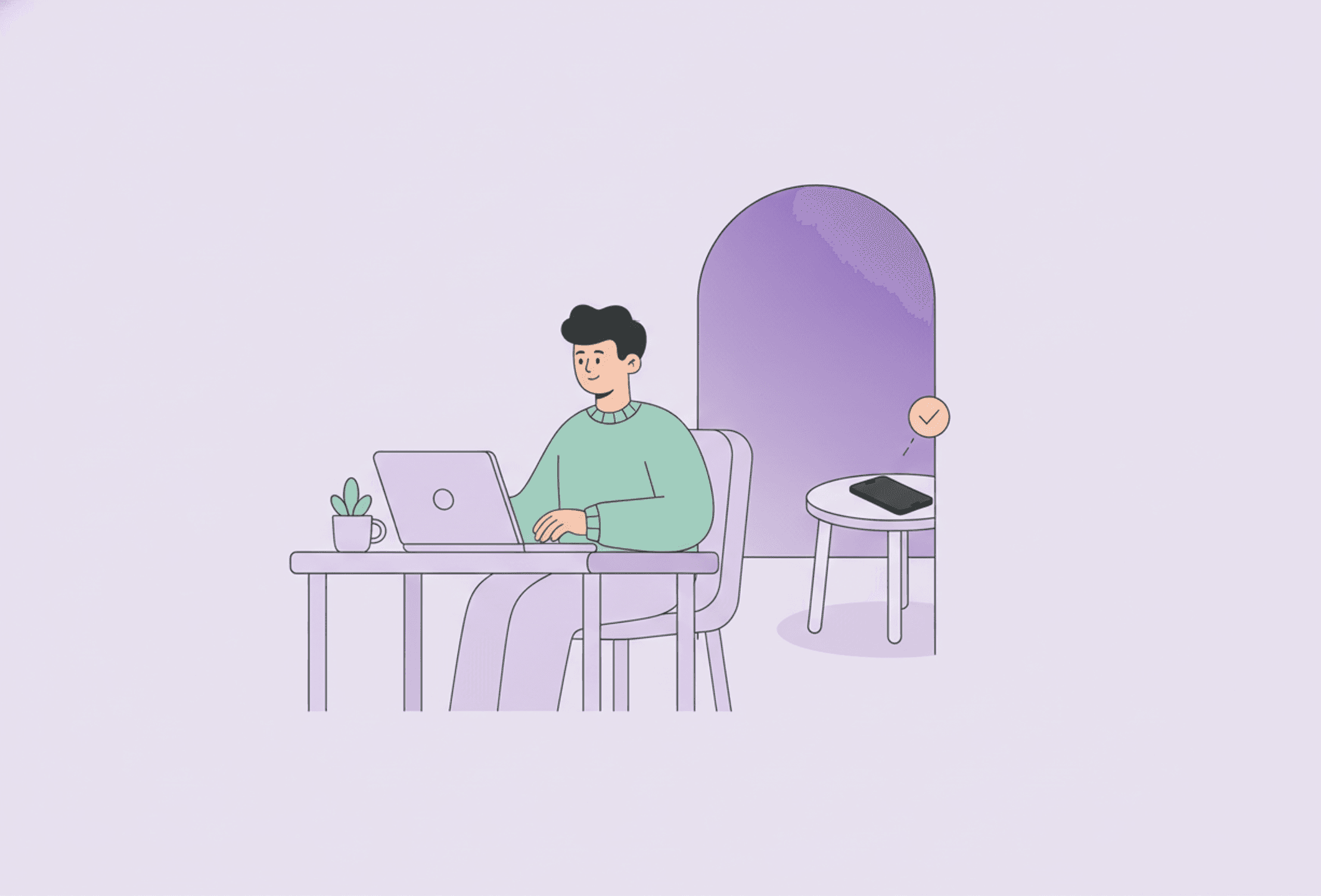
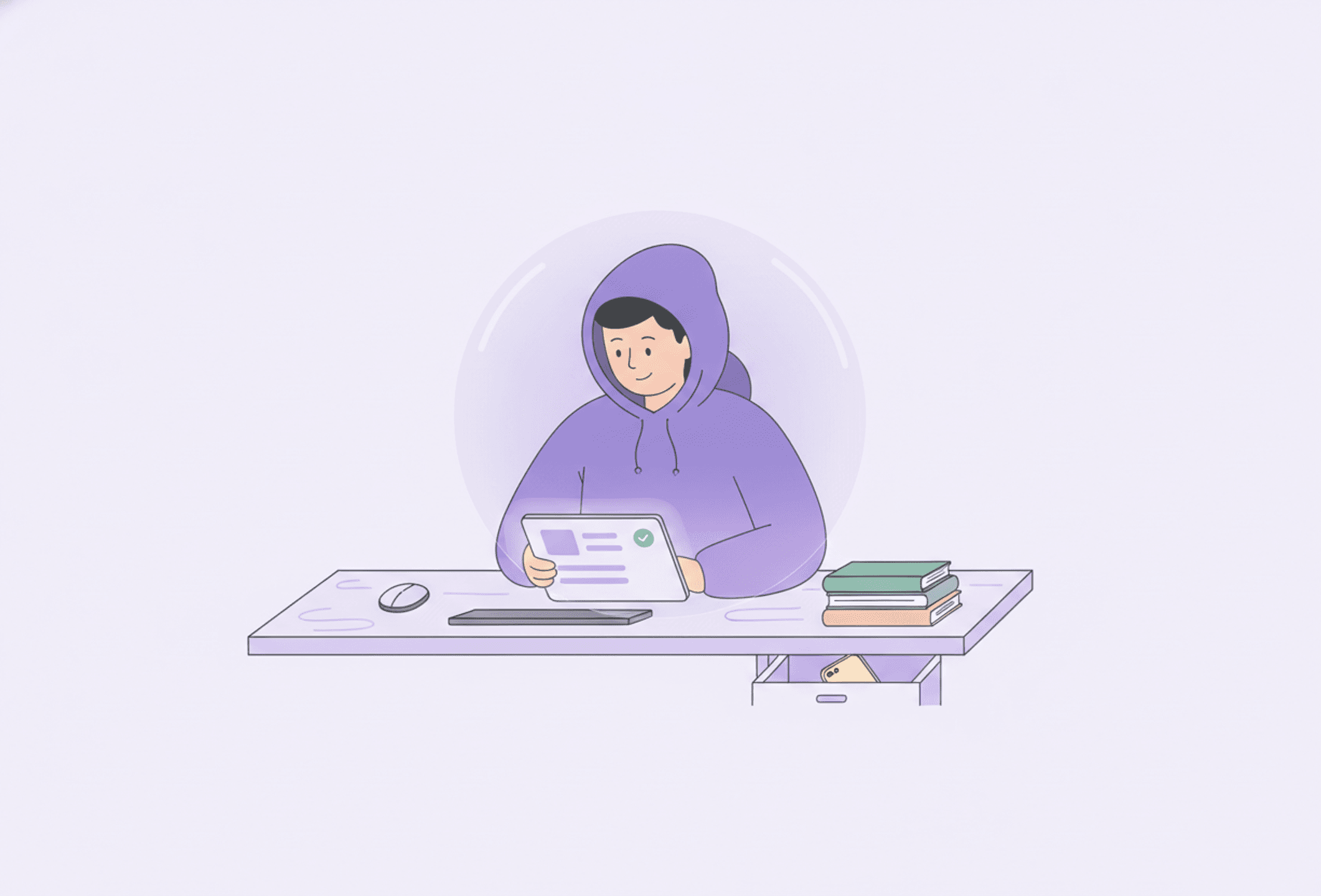
Not face down. Not in your pocket. In another room, or in a drawer you’d have to stand up to reach.
A visible phone pulls attention even in silence, because part of your brain keeps tracking it. Distance succeeds where discipline fails: when checking requires getting up, the impulse usually dies before you do. There’s a whole post on breaking the phone habit; for the workspace, one word covers it: elsewhere.
One screen state per task
Your screen is a workspace too, and an open tab is clutter that glows. Before starting: close everything the task doesn’t need, put the work in full screen, and silence notifications on the computer as well as the phone.
One task, one screen state. If the work takes four windows, four windows is the state — the point isn’t emptiness, it’s that nothing in view belongs to a different task.
Remove the starting friction
For ADHD brains, starting is the expensive part, and every setup step raises the price. A dead laptop, a missing charger, a document you have to hunt for — each is a perfectly good reason tomorrow-you won’t begin.
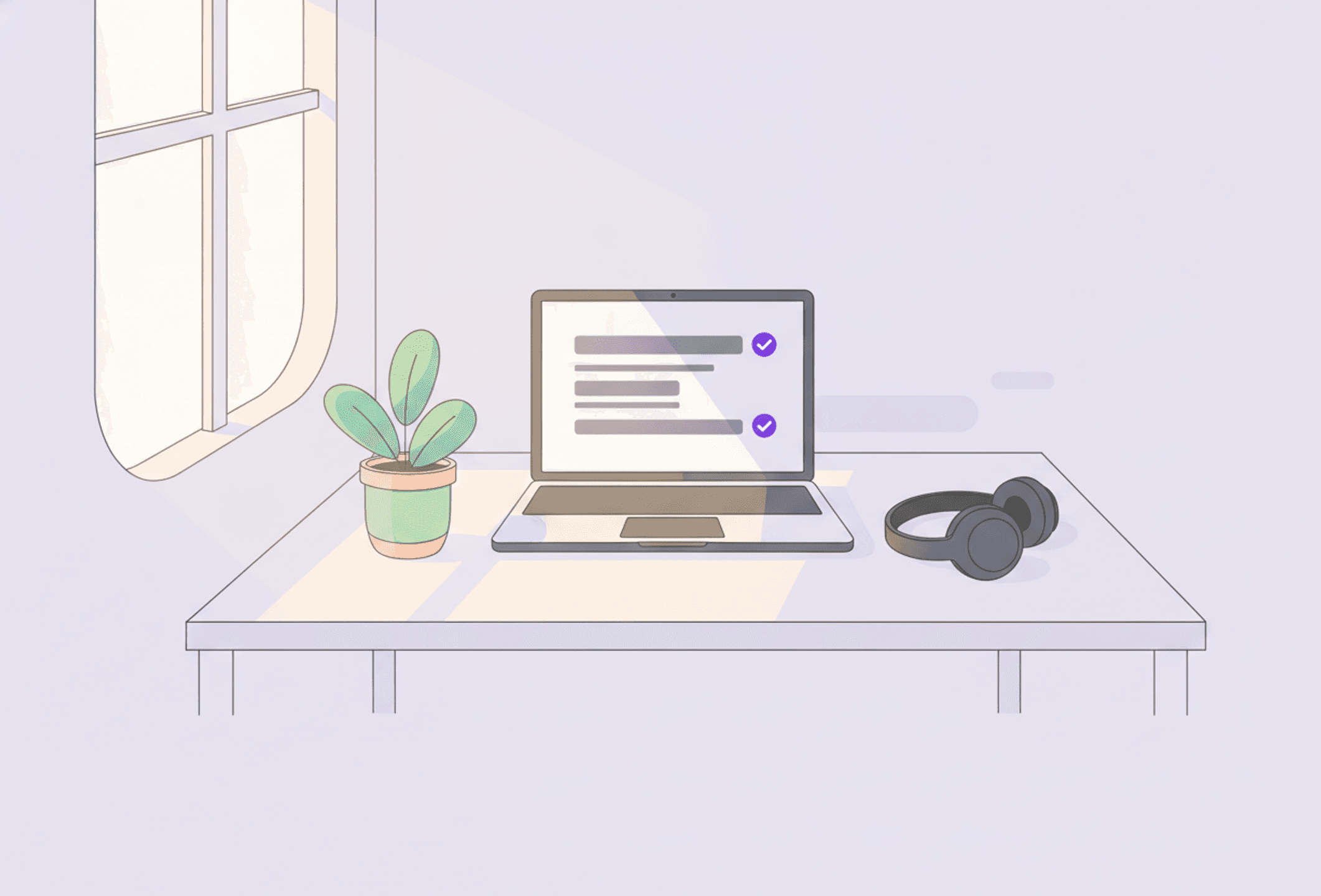
So stage the launch the night before: tools charged, documents ready, today’s notes where you’ll see them. Make the chair somewhere you actually want to sit. The goal is a workspace where starting requires nothing but sitting down.
Add a sensory layer
Focus isn’t only visual. Find the sound, light and temperature your brain settles at, and make them part of the setup: headphones with noise, music or silence, whichever works today; warm lamplight instead of a glaring overhead; a sweater within reach, because being cold is a distraction too. Keep something to fidget with on the desk — busy hands often make it easier for attention to stay put.
Sensory needs vary a lot, including within the same person across a day. Treat this layer as an experiment, not a rule.
Give your brain a “work mode” cue
The same place, the same playlist, the same drink: repeat a small combination every time you work and it becomes a signal that tells your brain which mode comes next. It’s the same mechanism as a transition ritual — the cue does the switching your willpower would otherwise have to.
Some people end the cue by pressing start on a focus timer; Stedo’s is free, and a kitchen timer works too. The specific cues matter less than their consistency.
No office? A corner or a tray counts
A focus workspace is a cue, not a room. In a small or shared home, a tray can be the workspace: laptop, headphones, notebook. Setting it out on the kitchen table starts work; packing it away ends it. A particular chair, corner, or even direction to face works the same way — the brain learns “this arrangement means work” as readily as it would learn a room.
Headphones do double duty here: sensory layer for you, do-not-disturb sign for the household.
End with a two-minute reset
The last move of the work day: two minutes, surface cleared, cups to the kitchen, tomorrow’s first task placed where you’ll see it. That’s the whole ritual.
It works because it moves tidying to the moment it’s cheap. Tonight it’s two minutes of putting things down; tomorrow morning it would be the barrier between you and starting. A clear surface at nine is the closest thing to a running start an ADHD brain can be handed.
Don’t let it grow into cleaning. Two minutes, surface only, done.
Read more
Frequently asked questions
Why does my workspace matter so much with ADHD?
Because ADHD attention goes to whatever is most stimulating in view, not to whatever is most important. Every visible object is a small invitation, and declining invitations all day is a losing game. A designed workspace removes them once, instead of asking you to resist two hundred times.
Where should my phone be while I work?
In another room, or in a drawer you have to stand up to reach. A visible phone pulls attention even when it’s silent, because part of your brain keeps tracking it. Distance adds a delay, and the impulse to check usually dies inside it.
I don’t have a home office. Can this still work?
Yes. A focus workspace is a cue, not a room. A tray with your laptop, headphones and notebook can be the workspace: setting it out on the kitchen table starts work, packing it away ends it. The brain learns an arrangement as readily as it learns a place.
What is the two-minute reset?
Two minutes at the end of the day: clear the surface, take the cups out, put tomorrow’s first task where you’ll see it. It moves tidying to the moment it’s cheap and hands tomorrow-you a clean start, which is when an ADHD brain needs the least friction.