

How to Tackle Doom Piles When You Have ADHD
Every doom pile is a stack of decisions you haven't made yet, not proof of laziness. Here's why ADHD builds them and how to clear one in about fifteen minutes.
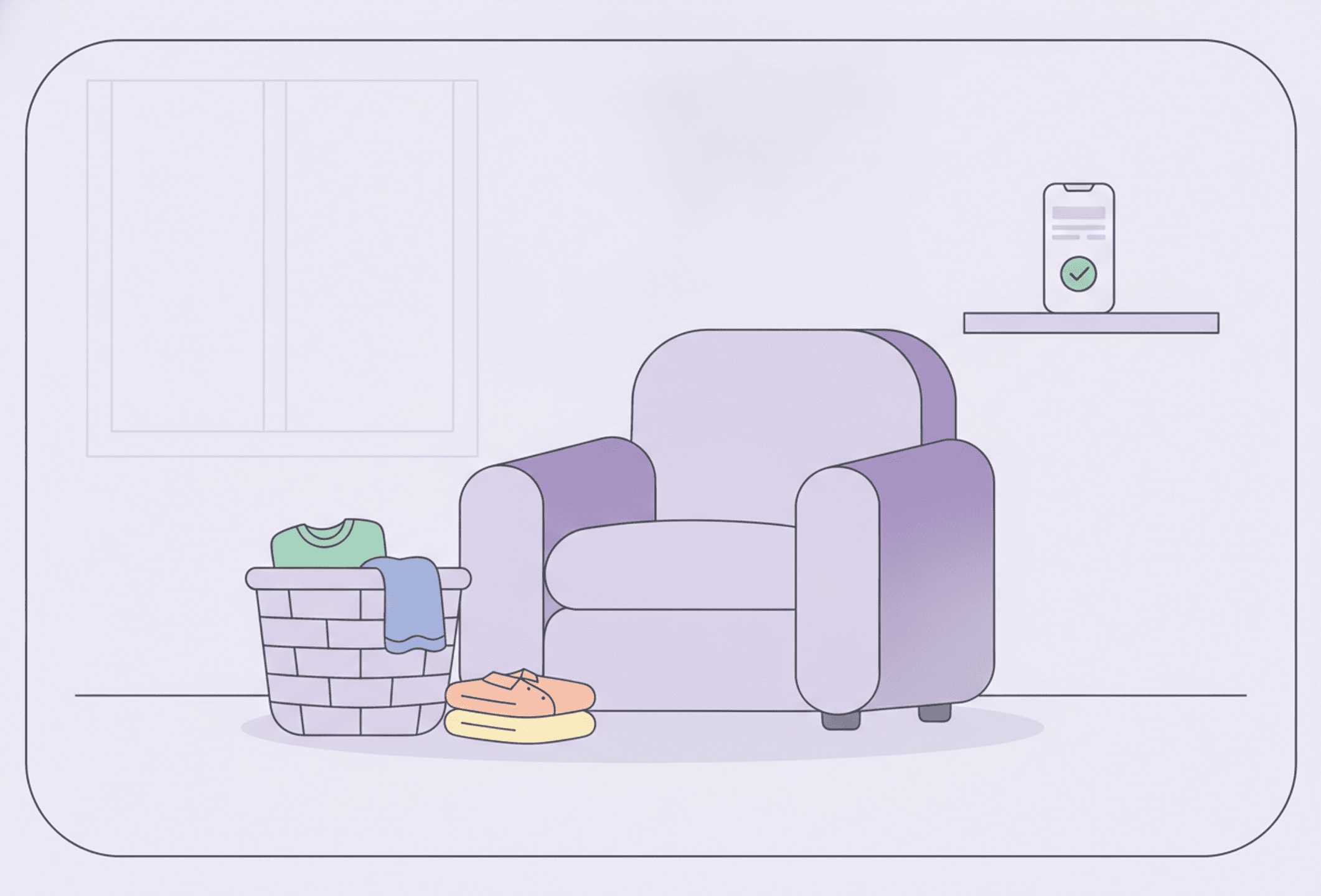
There's a chair in your bedroom that hasn't been sat on in months. The kitchen counter has a pile with geological layers. And somewhere there's a box of random things you've moved to three different spots without ever opening it.
A doom pile is a heap of unsorted stuff that grows because every item in it is a decision you haven't made yet — the ADHD community's backronym DOOM stands for "Didn't Organize, Only Moved". Chairs, counters, tote bags, entire boxes: the container varies, the mechanism doesn't.
Doom piles are common enough with ADHD to have earned their own name, and they're not what they look like from the outside.
Why ADHD brains build doom piles
Every item is a postponed decision
A pile looks like objects, but it's really a stack of decisions: keep or toss, where does this live, does something need to happen before it can be put away. Deciding runs on executive function, and executive function is exactly the resource an ADHD brain rations hardest. So each item gets the cheapest treatment available — put it down wherever you're standing — and the pile quietly banks one more decision for later.
Out of sight feels like gone
For many people with ADHD, things that leave your line of sight stop existing. Put the form in a drawer and it isn't filed, it's erased. Some part of you knows this, so it keeps everything out where it can be seen. A doom pile is your working memory made physical — which is why "just put it away" is advice your brain correctly refuses to take.
The whole pile reads as one giant task
Past a certain size, a pile stops being forty small items and becomes one enormous job. All-or-nothing thinking takes over: either I sort everything today or there's no point starting. Since everything is obviously too much, the answer is nothing, and the pile gains another layer.
Stored decisions, not laziness
Put those three together and a doom pile stops being embarrassing and starts being legible. It's a queue of deferred decisions, built by a brain that protects its scarce deciding power and doesn't trust drawers. The reframe is practical, not just kind: you don't clear a queue with guilt. You clear it by making the decisions cheap — smaller, faster, and fewer at a time.
How to tackle one doom pile
Pick one pile, not the room
The whole room is the all-or-nothing trap in a different outfit. Choose a single pile: the chair, one counter, one box. When it's done, you're done — even if the rest of the room looks exactly the same.
Set a timer for 10–15 minutes
A short, visible deadline changes what your brain believes it's agreeing to. You're not reorganizing your life; you're emptying one chair before the timer rings. Most single piles genuinely fit inside fifteen minutes, which surprises people who have dreaded them for months.
Sort into three boxes
Work top to bottom with three destinations:
- Belongs here — its home is in this room. Put it there now.
- Belongs elsewhere — into a box. Don't deliver anything yet.
- Bin — rubbish straight into a bag, donations beside it.
Speed beats precision. If one item eats more than ten seconds of deciding, it goes in the elsewhere box and you keep moving — that item is the doom, and it doesn't get to stall the other thirty-nine.
On a bad day, do five things
No capacity for boxes and timers? Take five items off the pile and deal with just those. It works for the same reason the five-minute rule works: shrinking the entry price is usually the entire battle. Sometimes five things turns into the whole pile — a bonus, never the assignment.
Deliver the elsewhere box in one trip
When the timer rings, walk the elsewhere box around your home in a single lap and drop each thing where it lives. The one-trip rule matters: carrying one bottle to the bathroom mid-sort is how you return twenty minutes later with three new objects and no memory of the mission.
Keeping the piles from coming back
Read the pile before you clear it
A doom pile is data about your home. Whatever shows up in it most — keys, chargers, mail, receipts — needs a real home within arm's reach of where it lands, not where storage logic says it should go. A hook by the door beats a beautiful key drawer in another room, every time. Storage that fights the landing spot always loses.
One landing basket per room, emptied on a schedule
You will not stop putting things down — that's the brain you have, so design for it. Give each room one deliberate landing basket: a doom basket you control beats five piles you don't. The basket is only a system if it gets emptied, so attach a ten-minute emptying round to something that already happens weekly — the end of your cleaning routine, or a Sunday evening reset. If the emptying lives as a recurring task with a reminder — in Stedo, for instance — it stops depending on you remembering it, which was always the weak link.
A doom pile was never a character flaw. It's a system that ran without anyone designing it. One pile, one timer, three boxes — and a basket with a schedule — is the designed version.
Read more
Frequently asked questions
What does DOOM stand for in doom piles?
It's a community backronym: Didn't Organize, Only Moved. A doom pile or doom box is stuff that got relocated rather than dealt with — the clothes chair, the counter pile, the box of random things that travels from room to room without ever being opened.
Why do people with ADHD have doom piles?
Three mechanisms stack up. Every item in a pile is a decision, and deciding costs executive function, which ADHD rations tightly. Things out of sight feel gone, so the brain keeps them visible on purpose. And past a certain size the pile reads as one giant task, so all-or-nothing thinking blocks starting at all.
How do I clear a doom pile without getting overwhelmed?
Shrink the job until it stops triggering dread: one pile only, a 10–15 minute timer, and a three-way sort — belongs here, belongs elsewhere, bin. Deliver the elsewhere box in a single trip at the end. On low-capacity days, just take five things off the top and deal with those.
Are doom boxes always a bad thing?
No. One deliberate landing basket per room, emptied on a schedule, is a system rather than a failure — it accepts that things get put down and gives them somewhere to wait. The difference between a doom basket and a doom pile is that the basket has a size limit and an emptying day.