Keeping Your Routines When You Live With Other People
Your morning sequence works perfectly. It works alone. Add one other person and it is gone by ten past seven.
Your morning sequence works. You built it carefully, it takes twenty-two minutes, and it holds.
It holds when you are alone in the flat. Add one other person's shower, one child who needs finding a sock, one partner who wants to talk about the weekend at ten past seven, and by half past you are standing in the kitchen with no idea which part you did.
Routines when you live with others fail for a specific reason: a routine built alone quietly assumes exclusive access to three things - time, space and objects - and in a shared home you have none of them by default. That makes the routine something to negotiate rather than something to design. And there is a second, more expensive problem, which is that most people hide their systems from the people they live with.
What a shared home actually takes from a routine
The slot. Your fifteen minutes in the bathroom are also somebody else's fifteen minutes, and whoever gets there first wins by accident rather than by agreement.
The surface. Your landing shelf by the door is also just a shelf, and shelves in shared homes accumulate other people's things.
The object. Somebody tidied your pile. They were being kind. The pile was your memory, and now it is in a drawer.
The quiet. The living room at eight in the evening is someone else's way of relaxing and, some days, your overstimulation.
None of that is anybody behaving badly. It is four ordinary collisions that a routine designed in a single-occupancy imagination does not survive.
Claim the time out loud
The fix for the slot is almost embarrassingly simple and most people do not do it: say it.
"I need the bathroom from seven to a quarter past, is that all right?" is a two-minute negotiation. Quietly resenting the collision, or losing your morning to it three times a week, is six months of friction. Most housemates and partners genuinely do not know your routine has a shape, because from the outside it looks like you wandering about.
Say which parts are fixed and which are flexible, and be specific about the times. A request with a number in it gets respected; a mood does not.
Stop hiding your systems at home
This is the big one. Many people run their alarms, timers, lists and piles slightly out of sight, so that the household does not see how much structure it takes - and home is the single most expensive place to be doing that, because it is where the systems are supposed to work and where you spend most of your unmonitored hours.
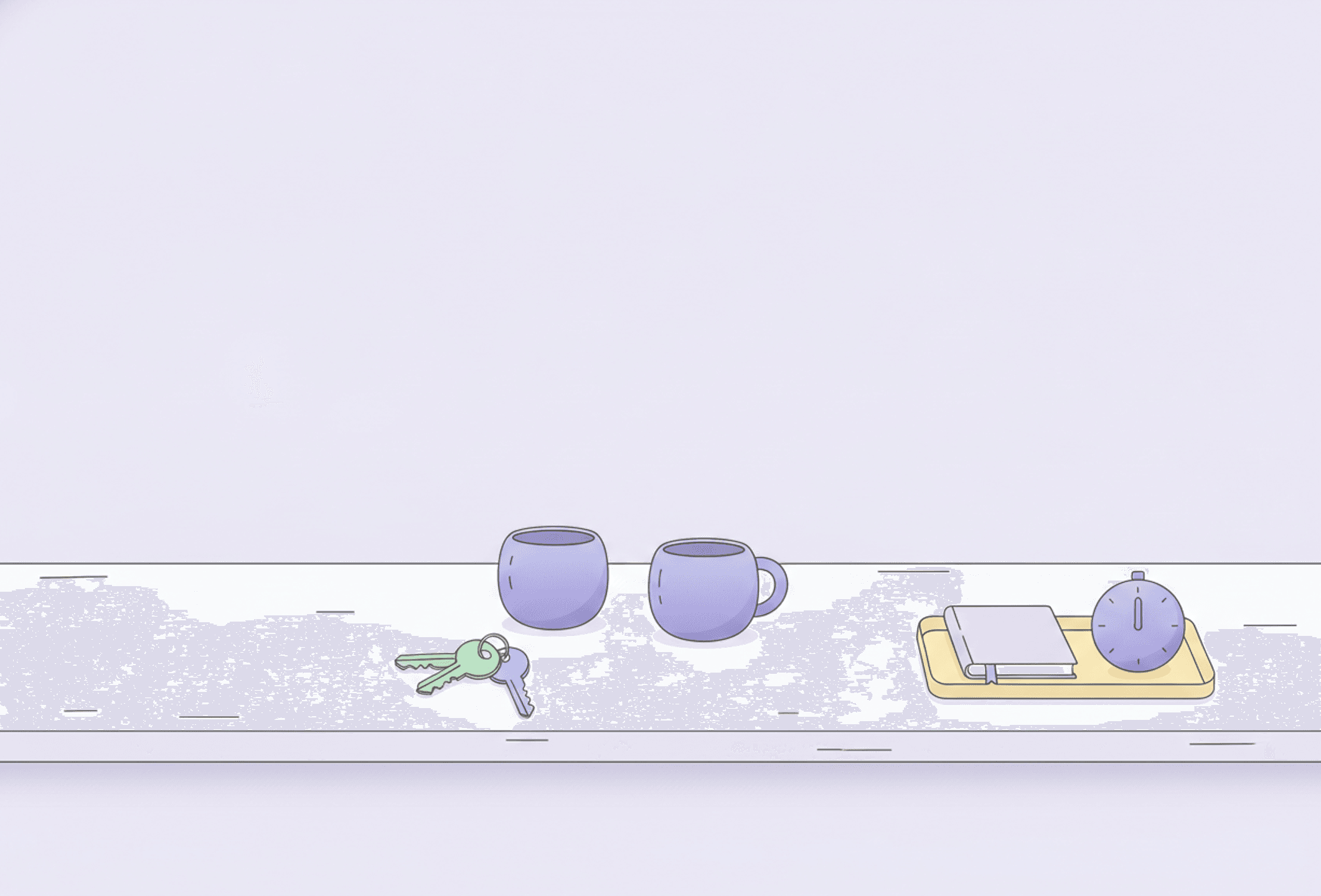
Let the timer sit on the counter. Let the alarm go off in front of people. Leave the list on the fridge. If it needs explaining, explain what the thing does rather than what is wrong with you: "the timer stops me losing an hour", not "I'm hopeless without it". Masking at home costs you the thing itself, not just the energy.
Get one square metre that is yours
You need a small amount of space that runs on your rules: one shelf, one drawer, one corner of the desk, one tray.
That is the practical answer to things ceasing to exist when they are put away, and it is the smallest possible version of designing your environment when most of the environment is not yours to design. Keep it small enough to be reasonable - a whole room is a negotiation, a tray is not.
"Please do not tidy my things away" is a real request
It sounds petty until you name the mechanism, which is that tidied and lost are the same event for you.
So say it once, kindly, with the reason: if it goes in a drawer I will not remember it exists - please leave this shelf alone, and I will keep it to this shelf. That last clause is what makes it fair, and it is usually the thing that gets the agreement.
Agree the standard per surface, not per person
Most household friction about mess is really a disagreement about which standard applies where.
Shared surfaces - kitchen table, sofa, hallway floor - run on the household's standard, and that is not negotiable just because your working style is different. Your surfaces run on yours. Getting explicit about which is which turns a recurring argument about character into a boring rule about furniture, and it pairs with how the chores themselves are split.
Don't make your partner your reminder system
Asking someone to remind you is the most natural request in the world and it slowly poisons things, because it turns a partner into a manager and you into someone being managed - and both of you will feel it long before either of you names it.
Put the reminding into something outside the relationship: a shared calendar, a whiteboard in the kitchen, an alarm. The system nags; the person does not. That distinction protects a surprising amount of goodwill, and it is one of the most useful ideas in ADHD and relationships.
Sync the week once, briefly
Ten minutes at the weekend: what is happening, who is out, who needs the car, what has to be bought, which evenings are already gone.
It prevents most of the week's collisions, and it means your own weekly planning is done against the real week rather than an imaginary one where you have every evening free.
Protect one quiet window
If noise is your issue, you need one predictable stretch that is yours - headphones on with the door shut, an hour before anyone else is up, a walk after dinner.
Ask for it as a scheduled thing rather than fleeing the room when it gets too much, which reads as a mood and creates its own conversation. "I'm going to take an hour on Tuesday evenings" is easy to agree to.
When there are children, the slot is not yours at all
With small children the honest position is that you do not control the mornings, so the anchor has to be either before anyone else is awake or attached to something that happens regardless.
Build the smallest version that survives a bad morning and treat the full version as a bonus. A routine that only works when the household cooperates is not a routine, it is a good day.
If you have no room of your own
Shared houses, small flats, someone else's spare room: the answer is a routine that travels.
One box or bag that holds the whole system, one square metre you set up and take down, and the entryway rules that only need a hook and a tray - the doorway habits work in almost any space and are the cheapest structure available when nothing else is yours.
The short version
A routine built alone assumes time, space and objects you do not have in a shared home. Claim the slot out loud with actual times, stop hiding your systems at home, and secure one square metre that runs on your rules. Ask explicitly that it is not tidied, and agree standards per surface rather than per person. Keep reminders in a shared calendar or a whiteboard rather than in your partner, sync ten minutes of the week together, and protect one predictable quiet window. With children, build the version that survives a bad morning - and if you have no space at all, use a routine that packs into a box.
Keep reading
Frequently asked questions
Why do my routines fall apart when I live with other people?
Because a routine built alone quietly assumes exclusive access to three things - time, space and objects - and a shared home guarantees none of them. Your fifteen minutes in the bathroom are also somebody else’s, your landing shelf is also just a shelf, and the pile that was holding your memory can be tidied away by someone being kind. That makes the routine something to negotiate rather than only something to design.
How do I ask for time or space without it becoming a row?
Be specific and put a number in it. "I need the bathroom from seven to a quarter past, is that all right?" is a two-minute negotiation; quietly resenting the collision is six months of friction. Same with space: ask for one shelf or one tray rather than a whole room, and add the clause that makes it fair - "leave this shelf alone and I will keep my things to this shelf".
Should I ask my partner to remind me about things?
Try not to. It is the most natural request in the world and it slowly turns a partner into a manager and you into someone being managed, which both of you will feel long before either names it. Put the reminding into something outside the relationship - a shared calendar, a whiteboard in the kitchen, an alarm - so the system nags and the person does not.
What if someone keeps tidying my things away?
Name the mechanism rather than the annoyance: tidied and lost are the same event when things cease to exist once they are out of sight. Say it once, kindly, with the reason and with your half of the deal - "if it goes in a drawer I will not remember it exists, so please leave this shelf, and I will keep my things to it." The second half is usually what gets the agreement.