

Reading With ADHD: Why the Same Paragraph Keeps Resetting
You have read the same paragraph four times. Your eyes moved every time. Nothing stayed - and reading it a fifth time is not the fix.

You have read the same paragraph four times. Your eyes moved across every line, correctly, in order. Nothing stayed.
So you read it a fifth time, slower, with a small clench of effort behind your forehead. It still does not stay, and now you are annoyed as well as lost.
Reading is not one skill. It is decoding the words, holding what you have just read while the sentence finishes, and staying interested enough to keep going - and ADHD mostly taxes the last two, not the first. Which is why reading it again almost never works: you are repeating the part that was never broken.
Why the paragraph resets
A sentence only makes sense if the beginning is still available when you reach the end. That holding job belongs to working memory, and with ADHD it has a smaller shelf. The start of the sentence falls off before the end arrives, so the words are all correctly read and nothing assembles.
The other half is that reading is unusually passive. It asks for continuous attention and gives almost nothing back - no click, no progress bar, no reply - which is exactly the profile of a task an ADHD brain drifts away from. Nothing has gone wrong when your mind wanders on page two. That is the predictable result of a low-feedback activity meeting an attention system that runs on feedback.
Make it active
The single biggest change is turning reading from input into a task with an output.
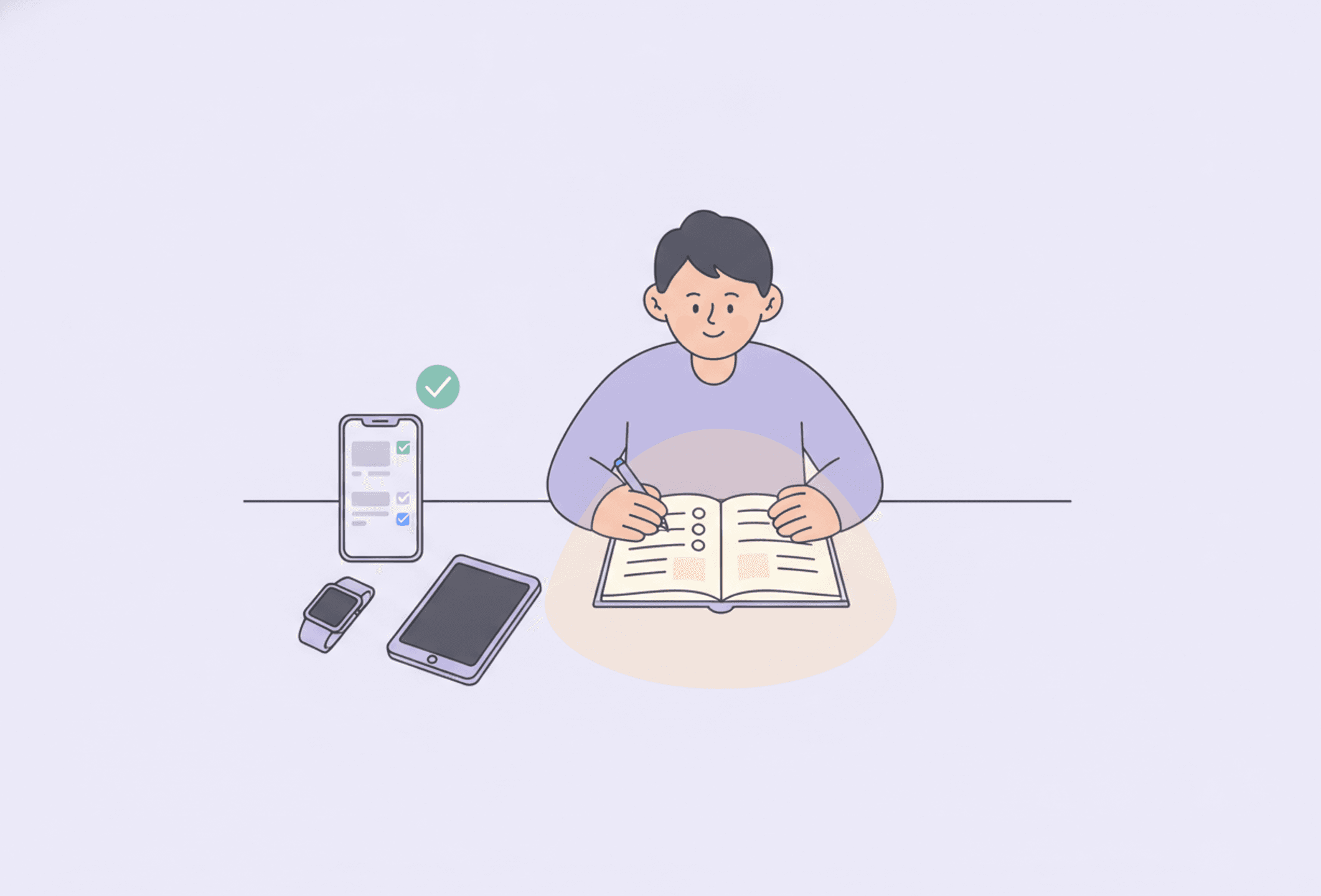
Read with a pen in your hand. Underline, star, scribble in the margin, argue with the author. It sounds trivial and it changes the activity completely, because now every paragraph has a small decision attached to it.
Ask a question before each section. Look at the heading and guess what it will say. Reading to check an answer keeps far better than reading to receive information.
One line per section. After each chunk, write a single sentence in your own words. If you cannot, you did not read it - which is worth knowing now rather than at the end of the chapter.
Say it out loud. Summarising a page to the wall, the dog, or an empty room forces the material through a second channel and instantly exposes what never landed.
Use your ears
Audio is not cheating, and "listening to a book counts as reading it" is not a controversial position among people who need to actually get through the material.
The strongest version is both at once: play the audiobook while following the text with your eyes. Two channels carrying the same content leave much less room to drift, and many people who cannot finish a page silently can finish a chapter this way.
Also use the speed control. Slightly faster than comfortable often improves attention rather than harming it, because the pace stops leaving gaps for your mind to wander into.
Shrink the unit
A chapter is not a reading unit; it is a folder. Read to the next subheading and stop. Set a timer for fifteen minutes rather than promising yourself an evening.
Keep a finger, a ruler or a folded card under the line you are on. It looks like something from primary school and it works, because it removes the constant micro-decision of where you are.
And if a page is genuinely dense, read it twice on purpose - once fast for shape, once properly. That is not the same as the involuntary re-reading loop; it is deliberate, and it ends.
Fix the conditions, not the willpower
Phone in another room, not face down on the table. One tab, one book, one thing at a time - reading while half-monitoring a chat is not reading.
Paper often beats a screen, mostly because paper cannot show you a notification. If it has to be a screen, use a reader view that strips everything else off the page.
Read when your attention is actually available. For most people that is earlier in the day rather than at eleven at night, when reading in bed becomes an elaborate way of not sleeping.
Stop the re-reading loop
Give yourself a rule: never read the same sentence more than twice. Keep going instead.
This feels wrong, and it works, because the next paragraph very often fills the hole the last one left. Comprehension does not arrive sentence by sentence; it arrives in blocks, and stalling on one line prevents the block from ever forming.
If you reach the end of a section and genuinely have nothing, then go back - once, with a pen, looking for the answer to a specific question.
For work reading, extract rather than absorb
Most reading for work does not need to be read. It needs to be mined for one or two things you actually require.
Write the question first - what do I need out of this? - then read the contents, headings, first sentences and conclusion, and stop when you have your answer. Finishing every page of a document you needed one number from is not thoroughness, it is a very slow way to procrastinate, which is worth naming if you are also avoiding the task itself. The same reading-with-a-purpose habit is what makes studying survivable.
Books that are not giving you anything
Boredom is information. If a book has done nothing for you in fifty pages, it is not a test of character - put it down.
Having three or four books on the go and reading whichever one has energy today is a perfectly functional system, and it beats the alternative, which is reading nothing at all for four months because one dutiful book is blocking the queue.
The short version
The paragraph resets because holding and interest ran out, not because you read the words wrong - so reading them again is the one thing that reliably fails.
Put a pen in your hand, read to the next heading, ask a question first, let audio carry you when your eyes will not, and refuse to read the same sentence more than twice.
Read more
Frequently asked questions
Why can't I remember what I just read?
Because holding the start of a sentence while you reach its end is a working-memory job, and with ADHD that shelf is smaller. The words get decoded correctly but nothing assembles into meaning. Reading is also unusually low in feedback - no click, no reply, no visible progress - which is exactly the kind of task attention drifts away from, so wandering on page two is the predictable result rather than a failure.
How do I stop re-reading the same paragraph?
Set a rule that you never read the same sentence more than twice, and keep going instead. It feels wrong, but comprehension arrives in blocks rather than sentence by sentence, and the next paragraph usually fills the hole the last one left. If you reach the end of a section with genuinely nothing, go back once with a pen, looking for the answer to a specific question.
Does listening to audiobooks count as reading?
For the purpose of actually getting through the material, yes. The strongest version is doing both at once - playing the audiobook while following the text with your eyes - because two channels carrying the same content leave much less room to drift. Using the speed control helps too: slightly faster than comfortable often improves attention rather than harming it.
How should I read for work with ADHD?
Extract rather than absorb. Write the question first - what do I need out of this? - then read the contents, headings, first sentences and conclusion, and stop as soon as you have your answer. Reading every page of a document you needed one number from is not thoroughness; it is a slow form of procrastination, especially if you are also avoiding the task the reading is for.