

How to Study With ADHD (When Rereading Does Nothing)
You reread the chapter three times and remember none of it. The problem is not effort. It is that rereading is the least effective method there is.

You sat with the textbook for two hours. You highlighted a lot. It felt like studying. And when you close the book, almost nothing is there.
Studying with ADHD works when you make it active, short and externally structured - because rereading and highlighting are the two least effective study methods known, and they are exactly the two that feel most productive. That mismatch is the whole trap. Passive reading gives you the pleasant sensation of familiarity, which your brain misreads as knowing.
The good news is that the methods that actually work happen to be the ones an ADHD brain tolerates better anyway: shorter, more interactive, with visible feedback.
Stop rereading. Start retrieving.
The single biggest upgrade is active recall: instead of putting information in again, pull it out.
- Close the book and write down everything you remember from the section. Then open it and see what you missed.
- Turn every heading into a question and answer it out loud without looking.
- Use flashcards for anything factual - but write the cards yourself, because writing them is half the learning.
- Explain the concept as if to someone who has never heard of it. Where you get vague is exactly what you do not know yet.
Retrieval feels harder than rereading, and that difficulty is the point - it is the effort of pulling something out that makes it stick. Rereading feels smooth precisely because nothing is being built.
Spread it out. Twenty minutes on four days beats eighty minutes the night before, by a wide margin. Revisiting material after you have partly forgotten it is what moves it into long-term memory, which is also why last-minute cramming produces knowledge that evaporates the week after the exam.
Short blocks, visible time
Two-hour study sessions are a fantasy for most brains and a guaranteed failure for an ADHD one. Work in 25-minute blocks with 5-minute breaks - the Pomodoro technique - or shorter if 25 is too long today. Fifteen minutes of real attention is worth more than two hours of sitting near a book.
Use a timer you can see. Time that is visible stops you from either grinding past your limit or drifting off entirely, and it makes the end of the block a fact rather than a negotiation. Stedo's focus timer is free and runs Pomodoro cycles with breaks, so the timer sits in the same place as your task list.
One rule for the breaks: do not open your phone. A five-minute break becomes forty on a screen. Stand up, get water, look out of a window.
Break the mountain into steps
"Study for the exam" is not a task, it is a mood. It has no beginning, so nothing starts.
Before each session, write down the specific, finishable thing: "read chapter 4 and write five questions from it", "do problems 12-18", "make cards for the six definitions". You should be able to tell when you are done. The mechanics of cutting something big into real steps are in how to break down a task, and it matters more for studying than for almost anything else, because a syllabus is the biggest vague blob you will ever face.
A useful trick when you cannot start at all: do the easiest possible part first. Not the most important part - the easiest. Momentum is the resource in short supply, not judgement about priorities.
Study near another person
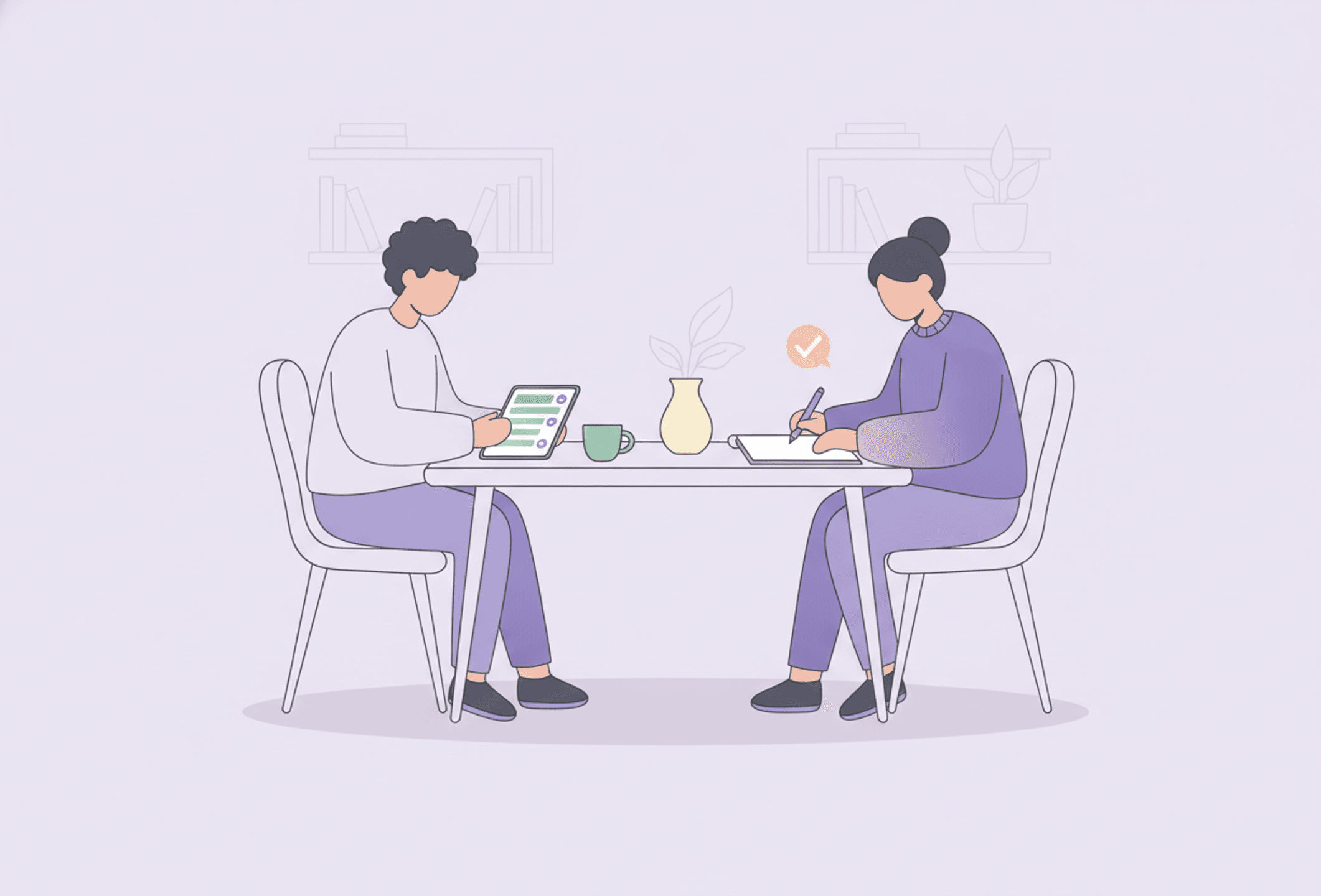
Body doubling - working in the presence of someone else, not necessarily with them - is unreasonably effective for study, and it is why libraries work when kitchen tables do not. A silent video call with a friend who is also working counts. So does a café, a study room, or a co-working stream.
You are not borrowing their knowledge. You are borrowing the mild social pressure that keeps you in the chair.
Set the room up so it does the work
- One surface, one subject. Everything else off the table. Visible objects are open loops.
- Phone in another room, not face-down beside you. Distance beats willpower every time.
- Same place every time, if you can. The location becomes a cue, and cues do work that motivation does not have to.
- Something to write with, always. Studying should produce marks on paper. If a session generated nothing written, it was probably reading, not studying.
Work with your energy, not against it
Notice when your brain is actually able to think, and put the hardest material there. Reading dense theory in your worst hour is not discipline, it is scheduling a failure - and then reading the failure as evidence about your intelligence.
Save the low-effort study jobs - organising notes, making cards, tidying references - for the flat hours. They still count, and they are far better than a foggy hour of pretending to read.
Two things that are not laziness
Forgetting what you just read is working memory, not carelessness. Take notes as you go so the page holds it instead of your head.
Needing more breaks than other people is capacity, not weakness. Someone who studies four focused 25-minute blocks learns more than someone who sits for four hours and absorbs an hour's worth.
The short version
Test yourself instead of rereading. Work in short timed blocks with real breaks. Turn the syllabus into finishable tasks. Sit near someone. Put the phone in another room.
None of it requires becoming a different kind of student. It requires giving up the methods that only feel like studying - and those methods were never working for anyone, ADHD or not.
Read more
Frequently asked questions
What is the best way to study with ADHD?
Active recall in short timed blocks. Close the book and write or say what you remember, then check - retrieving information is what makes it stick, while rereading and highlighting mostly produce a feeling of familiarity. Work in 25-minute blocks with real breaks, turn the syllabus into specific finishable tasks, and study near another person if you can.
Why can't I remember what I just read?
Because reading is passive, and passive input barely registers when attention has drifted - which it does often, and without announcing itself. It is a working-memory issue rather than carelessness. Take notes as you read so the page holds the information instead of your head, and stop every section to say out loud what it was about.
How long should an ADHD study session be?
Twenty-five minutes of focused work with a five-minute break is a good default, and fifteen is fine on a bad day. What matters far more is that the block is timed and visible and that the break is real - meaning no phone, since a five-minute screen break reliably becomes forty. Four focused blocks beat four unfocused hours.
Is cramming ever a good idea?
It can get you through tomorrow's exam, but it produces knowledge that disappears within days, so anything cumulative will cost you later. Spacing the same total time across several days works substantially better because revisiting material after partly forgetting it is what moves it into long-term memory. If you must cram, use active recall rather than rereading - it is the more efficient use of the hours you have left.