

Why You're Always Late (and How to Leave on Time)
You left in plenty of time and arrived late again. Chronic lateness is not carelessness - it is three separate mechanical failures that happen to end in the same place, and each one has its own fix.
You set off in plenty of time. You arrived late anyway. Again. If why am I always late is a question you have put to yourself more than once, the honest answer is far more mechanical than it feels. And the worst part is the story it seems to tell about you - that you do not care enough, or do not respect other people's time, neither of which matches how bad you feel in the car.
Chronic lateness is usually not carelessness. It is three separate mechanical failures that happen to end in the same place: an estimate of the wrong thing, a transition that is hard to make, and one more thing at the door. Each has its own fix. Trying to fix "being late" as a personality trait does nothing at all, which is why decades of trying harder have not worked.
If you have ADHD, time blindness explains why the estimate goes wrong. This article is about what to do at the door.
Failure one: you estimate the journey, not the trip
The journey is twenty-two minutes. The trip is: finish what you are doing, find your keys, shoes, coat and bag, check you have the thing you need, lock up, walk to the car, drive twenty-two minutes, park, walk from the car park, find the right entrance. That is forty minutes.
You did not misjudge the drive. You budgeted for one component and paid for eleven.
The fix is to plan backwards from arrival and count the invisible minutes. Write it out once, properly, for the journeys you make often - the school run, the commute, the physio. Almost everyone finds twelve to twenty minutes they have never once counted.
Failure two: leaving is a transition
Being on time requires stopping something. If you are mid-task, stopping is expensive. If you are mid-interesting task, stopping can be close to impossible.
This is why lateness clusters on the days you were absorbed in something, not the days you were idle. The problem is rarely that you forgot. The problem is that you knew, and could not put the thing down.
Set alarms for leaving, not for the appointment. Two of them: one at "start wrapping up", one at "you are walking out of the door now". The first is the trigger for a transition ritual - save the file, close the tab, stand up - rather than a polite suggestion.
And one rule for the second alarm: whatever is in your hands goes down. Not finished. Down. This is the single most effective rule here and by far the hardest to keep, because the thing in your hands is always nearly done. It is never nearly done.
Failure three: the door
You are dressed, you are on time, and then: water the plant, send one email, change your shirt, feed the cat a second time. The one-more-thing at the door is a real and specific phenomenon. It happens because you have spare minutes and a brain that will fill any spare minutes it is given.
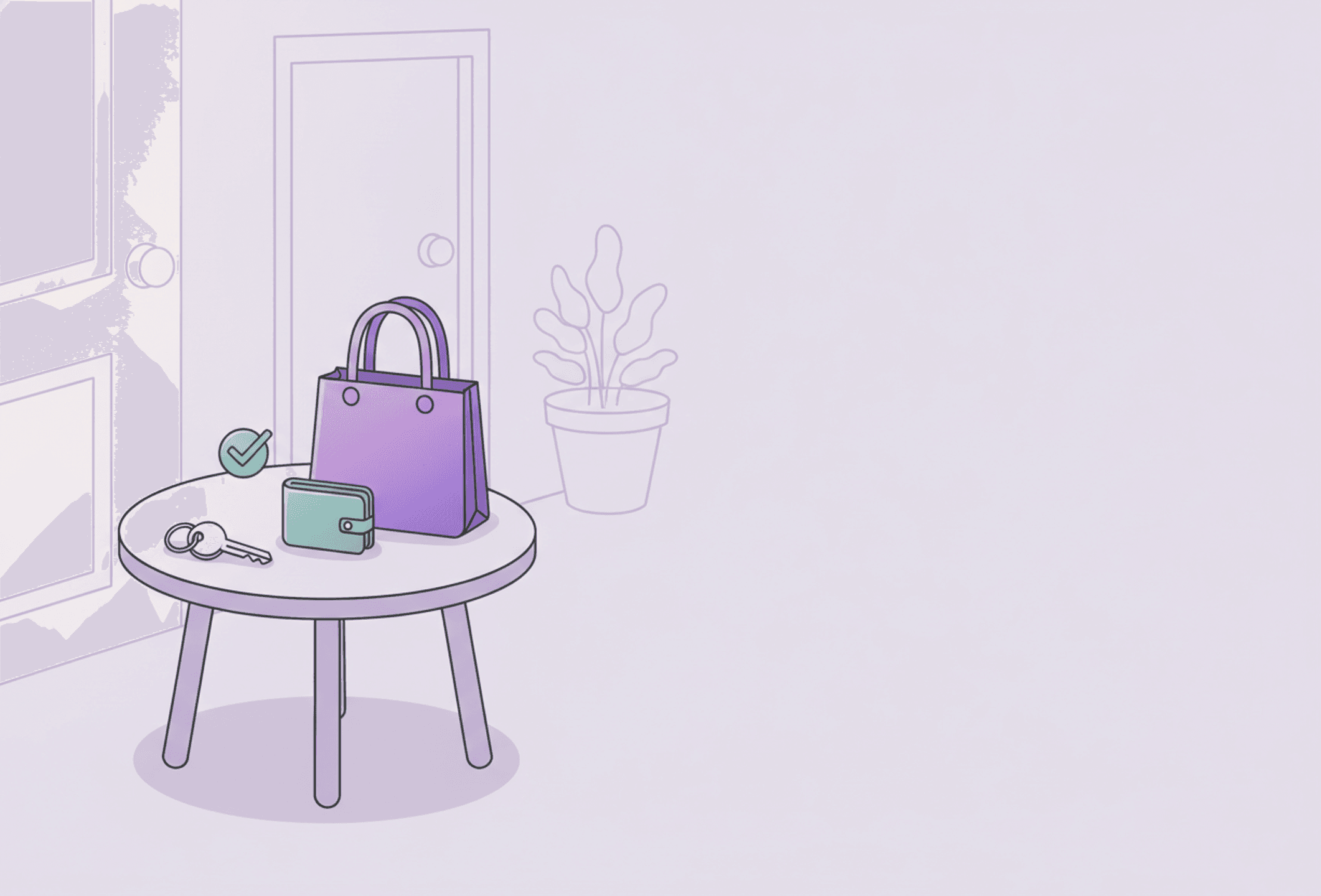
Build a launch pad. One surface by the door where keys, wallet, bag and anything needed tomorrow live permanently, packed the night before wherever possible. Nothing to search for means nothing to get distracted by while searching, which is where most of those minutes actually go. It is a direct counter to out of sight, out of mind at the exact point where it costs the most.
The part nobody says out loud
Here is the uncomfortable one. A great deal of chronic lateness is not bad planning at all. It is an unwillingness to arrive early - because arriving early means waiting, and waiting with an ADHD brain is genuinely unpleasant. Empty minutes in a corridor with nothing to do feel like a punishment.
So you calibrate, without ever deciding to, for arriving exactly on time. And a plan aimed at exactly on time arrives late roughly half the time, because that is what an average means.
Make early comfortable in advance. A book in the bag. A podcast already queued. A game on the phone you actually like. A café near the venue you look forward to. Once ten minutes early is pleasant instead of punishing, your calibration shifts on its own - and for many people this is the change that finally makes all the other advice work.
A worked example
Appointment at 14:00, twenty-two minutes away.
- Aim to arrive 13:50, not 14:00.
- Six minutes from parking to door, so park at 13:44.
- Twenty-two minutes driving, so in the car at 13:22.
- Eight minutes for shoes, coat, keys, locking up, so stop what you are doing at 13:14.
- Wrap-up alarm at 13:05. Leaving alarm at 13:14.
You leave forty-six minutes before an appointment that is twenty-two minutes away. It feels absurd written down. It is also precisely why people who are never late are never late.
Read more
Frequently asked questions
Why am I always late even when I try hard not to be?
Because effort is aimed at the wrong thing. Lateness is usually three mechanical failures: you estimated the journey rather than the whole trip, you could not make the transition out of what you were doing, and you added one more thing at the door. Trying harder does not address any of the three; changing the plan, the alarms and the doorway does.
Is chronic lateness an ADHD thing?
It is very common with ADHD, largely because of time blindness - difficulty sensing how long things take - and because stopping an absorbing task is genuinely hard. It is not exclusive to ADHD, and it is not a statement about how much you care. It is a scheduling and transition problem with practical fixes.
What is the single most effective fix?
Set the alarm for leaving rather than for the appointment, and follow one rule when it goes off: whatever is in your hands goes down, unfinished. Most late arrivals are decided in the five minutes when you knew you should leave and finished one more thing instead.
How do I stop adding one more thing at the door?
Remove the spare minutes and the searching. Keep a launch pad by the door with keys, wallet and bag permanently there, packed the night before. Then make arriving early genuinely pleasant - a book or a podcast in the bag - so those minutes stop feeling like something to be filled at home.