

Eating With ADHD: Why Meals Disappear From the Day
It is three in the afternoon, you have not eaten, and you are furious about something small without being able to work out why.
It is three in the afternoon. You have had two coffees. You are irritated about something small, slightly shaky, and unable to make the simplest decision - and it takes another twenty minutes to work out that you have not eaten anything today.
Eating with ADHD is rarely an appetite problem. It fails at three specific points: noticing that you are hungry, deciding what to have, and actually starting the task of making it. Each of those has a different fix, and none of them is remembering harder.
This is general information, not medical or nutritional advice.
Point one: you do not notice
Interoception - reading your body's signals - is often less reliable with ADHD. Hunger arrives quietly, gets outcompeted by whatever you are doing, and then shows up in disguise: as irritability, as a headache, as sudden inability to make decisions, as feeling near tears about something minor.
So stop relying on hunger as the trigger. Anchor meals to the clock or to an event, not to a feeling. An alarm at twelve. Lunch after the morning meeting. Something to eat when you come back from the school run.
And when the alarm goes and you are not hungry, eat something anyway. Waiting for the signal means eating at four, and by four the day has already been damaged.
Point two: you cannot decide
Opening the fridge and asking what do I want? is a decision, and by evening you have no decisions left. That is why people who can cook perfectly well end up eating cereal standing up.
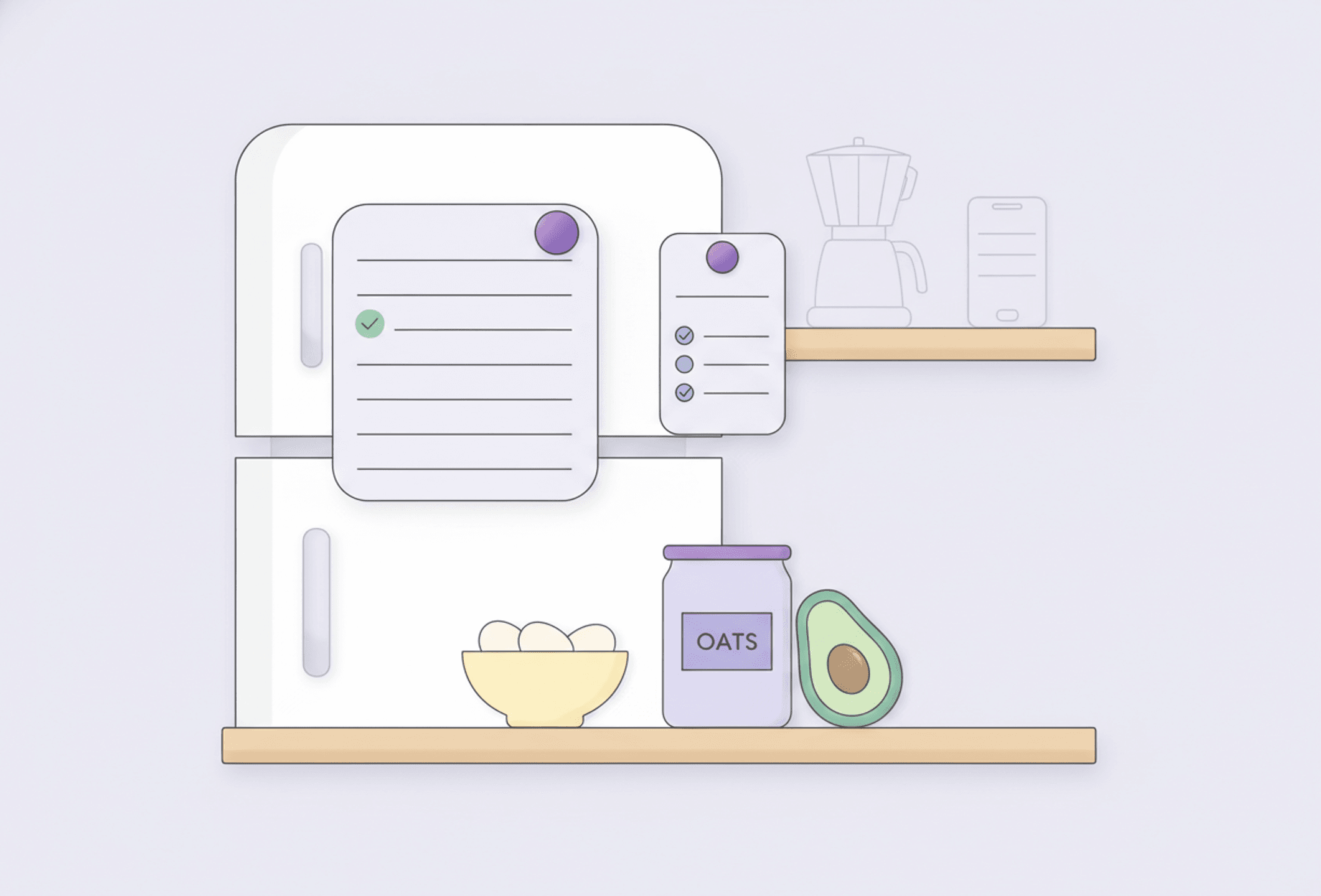
The fix is to make the menu smaller, not better. Pick five to seven dinners you can actually make, put them on rotation, and stop trying to eat something different every night. Repetition is not a failure of imagination - it is what removes the daily decision, which was the actual obstacle. That is what meal planning is really for.
Decide once, at a calm moment, and let the plan handle the hungry version of you who cannot think.
Point three: you cannot start
A cooked meal is a multi-step task with no urgency attached until it becomes an emergency. There is no reward for starting it and the reward for finishing it is forty minutes away.
So keep food that does not require a task. Assembly food - things that count as a meal with no recipe and no decisions:
- Bread, cheese, tomatoes, hummus.
- Yoghurt, fruit, nuts.
- Tinned fish, crackers, pre-washed salad.
- Frozen meals that go in the oven with no thought at all.
- Whatever you can eat standing at the counter.
This is not a lesser way of eating. A yoghurt and a banana at one o'clock beats a beautifully imagined meal at four that never happened.
And cook double when you do cook. The version of you who put a portion in the freezer on Sunday has done more for Wednesday than any amount of resolve.
Hyperfocus eats your meals
Hyperfocus does not include an off switch for hunger. Six hours pass, you look up, and you feel terrible - not because the work was hard but because you have run the whole afternoon on nothing.
Set an alarm before you start something absorbing. Put a snack physically on the desk, in view, so eating does not require leaving the chair. If you cannot bring yourself to stop, eat something with one hand and carry on.
Also keep water where you work. Dehydration produces almost exactly the same symptoms as the fog you were blaming on the task.
The evening pattern
If you eat almost nothing all day and then eat continuously from six o'clock onwards, that is not a discipline problem. It is what a body does after a day of nothing, and it is energy management failing much earlier in the day.
The leverage is at breakfast and lunch, not at nine in the evening. Eating something before ten in the morning - even something small and unimpressive - changes the entire shape of the evening.
A note on medication
Some ADHD medication reduces appetite, sometimes considerably. That is a common and well-known effect, and it is worth mentioning to whoever prescribes it rather than working around it silently.
Practical things that often help: eat before it takes effect rather than waiting to feel like it, keep drinks with calories in them for the flat part of the day, and plan the main meal for the evening when appetite tends to return. Anything beyond that is a conversation with your prescriber, not with the internet.
Shopping for the person you are
Shop for the version of you who is tired on Wednesday, not the aspirational one who will make a stew on Tuesday. Frozen vegetables count. Pre-chopped things count. Ready-made sauce is not cheating.
And keep a repeating list - the same twenty items you always need - so the shop is not a fresh act of recall every week. Ingredients that need a plan to become food will rot; food you can eat with no further steps will get eaten.
When it is more than logistics
If you regularly go entire days without eating, if food causes real distress, or if patterns around eating have become something you feel ashamed of, that goes beyond routines and hacks. It is worth talking to a doctor - eating difficulties are common alongside ADHD, and they are treatable.
The short version
You are not skipping meals through carelessness. You are missing a quiet signal, running out of decisions, and facing a multi-step task with no urgency.
So: put lunch on the clock and eat when it says so, shrink dinner to five options on rotation, keep food that needs no recipe, set an alarm before you disappear into something, and eat something before ten in the morning. The rest of the day behaves differently when you do.
Read more
Frequently asked questions
Why do I forget to eat with ADHD?
Because reading your body's signals is often less reliable with ADHD, so hunger arrives quietly, loses out to whatever you are doing, and then turns up disguised as irritability, a headache or sudden inability to decide anything. The fix is to stop using hunger as the trigger and anchor meals to the clock or to an event instead - and to eat at that time even when you do not feel hungry.
How do I make dinner happen when I cannot decide?
Make the menu smaller rather than better. Pick five to seven dinners you can actually make and put them on rotation, so the daily decision disappears - repetition is not a failure of imagination, it is what removes the obstacle. Decide at a calm moment and let the plan handle the hungry version of you, who has no decisions left.
What should I keep in the house?
Assembly food: things that count as a meal with no recipe and no decisions. Bread, cheese and tomatoes; yoghurt, fruit and nuts; tinned fish and crackers; frozen meals that go straight in the oven. A yoghurt and a banana at one o'clock beats a beautifully imagined meal at four that never happened, and cooking double so a portion goes in the freezer does more for Wednesday than any amount of resolve.
Why do I eat nothing all day and then everything at night?
Because that is what a body does after a day of almost nothing - it is not a discipline problem. The leverage sits at breakfast and lunch rather than at nine in the evening, so eating something before ten in the morning, even something small, changes the shape of the whole evening. If eating causes real distress or you regularly go whole days without food, that is worth raising with a doctor.