

Stack Small Wins to Build Momentum
The strongest daily motivator isn't pressure — it's visible progress, and small wins count in full. Here's how to engineer one guaranteed win and let it chain into the work that matters.
The important task has been on your list for a week. Every day you circle it, do everything else instead, and end the evening with nothing to show for it but a slightly worse opinion of yourself. The list isn't the problem — the scoring system is.
Small wins — pieces of progress you actually finish and actually see — are the strongest daily driver of motivation research has found. Not pressure, not deadlines, not motivation videos: visible progress. Which means the most practical way to change how your days feel is to engineer wins on purpose.
The progress principle
Harvard researcher Teresa Amabile and psychologist Steven Kramer analysed nearly 12,000 daily diary entries from 238 professionals to find out what separates good workdays from bad ones. The answer was remarkably consistent: the best days were the ones with progress in meaningful work, and the size of the step barely mattered. Minor, incremental wins lifted motivation, mood and creativity almost as much as major breakthroughs.
The finding has a sharp edge too: setbacks pull you down roughly twice as hard as progress lifts you up. A day with no visible win isn't neutral — it quietly drains the will to start again tomorrow. Which is exactly why leaving wins to chance is a bad plan.
Why this matters more with ADHD
The ADHD reward system runs on now. Distant, abstract payoffs — the finished thesis, the organised home, the promotion in two years — barely register as rewards at all, while quick, concrete completion delivers a real hit of done. It's why a game that pays out every ninety seconds can swallow a whole evening while the important project sits untouched: the game has a better payout schedule, not a better claim on your life.
Engineering small wins isn't cheating, and it isn't lowering the bar. It's giving the work that matters the payout schedule your brain actually responds to.
Start the day with one guaranteed win
Before the day gets complicated, finish one thing that cannot fail. Make the bed. Empty the dishwasher. Put yesterday's cup in the sink and tick it off. The task being trivial is the point: the win must be certain.
What you're buying is the opening score. A day that starts 1–0 gets approached by someone who finishes things; a day that starts with scrolling and dread opens with a quiet loss. Same morning, same person — different trajectory.
Shrink the task until a win is certain
Big tasks produce no wins because they can't be finished today. “Write the report” can't be ticked off this afternoon, so the only thing it generates is another daily experience of not finishing.
So cut off a piece you can finish: not “write the report” but “write three ugly sentences of the intro”. If even that stalls, keep shrinking — the two-minute rule exists precisely because a step small enough to be trivial is a step that reliably gets started. The goal isn't the three sentences. The goal is the tick, and the window it opens.
Make small wins visible
A win you don't register pays nothing. Amabile's research ran on diaries for a reason: progress has to be noticed to do its work, and finished tasks have a way of evaporating from memory the second they're done.
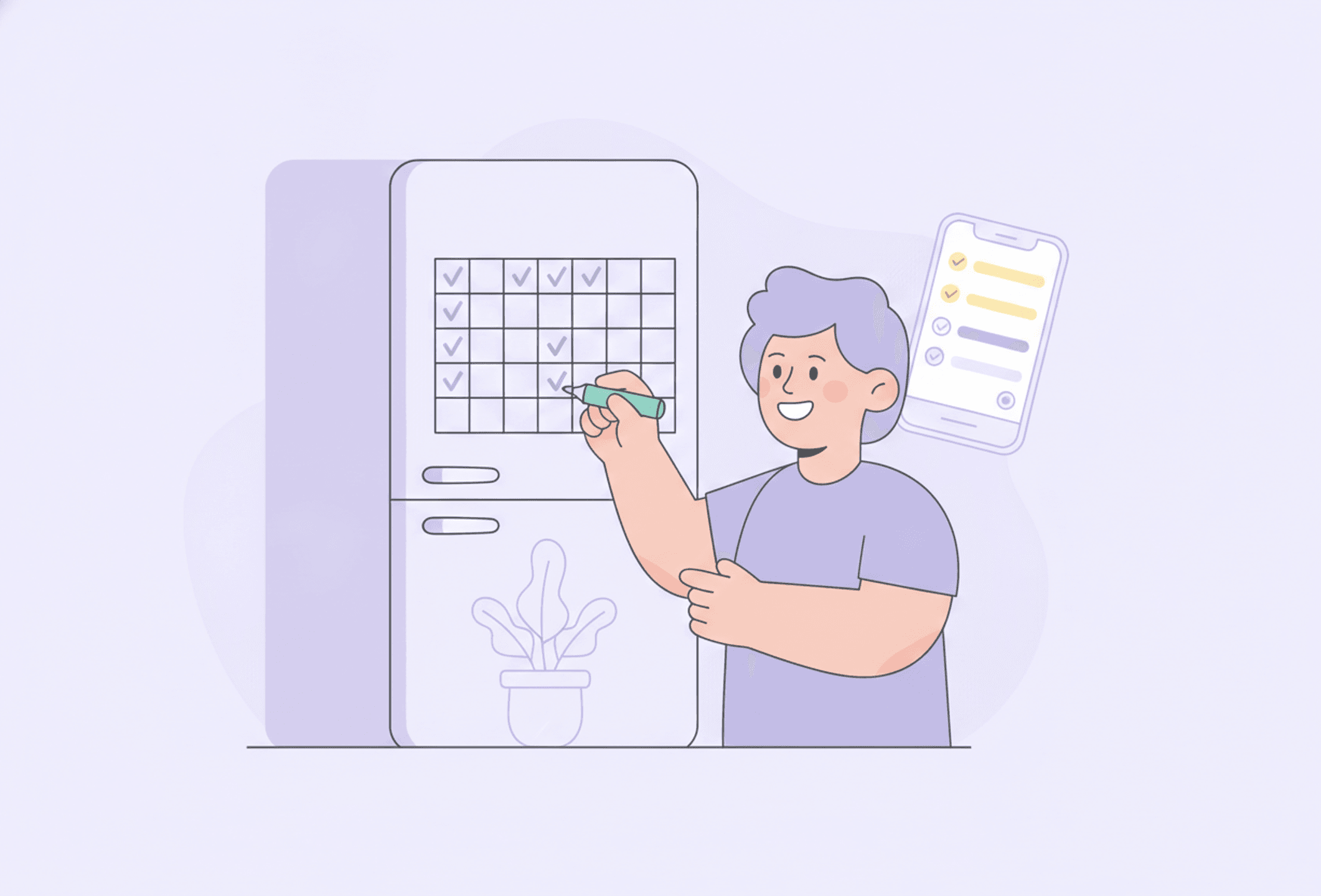
- Tick it off, physically. The checkmark is a small ritual that converts effort into a recorded win. Don't do the task and skip the tick.
- Keep a done list. Next to the to-do list, write down what actually got finished, including the unplanned things. On a rough day it's evidence against the “I did nothing” story; over a week it's a visible pattern.
- Let something count for you. This is the honest use of gamification: points, streaks and a history make wins accumulate somewhere you can see them. In Stedo, every completed task and routine earns points and extends a streak, which sounds trivial right up until you feel the pull of not breaking it.
None of this is decoration. Seeing the win is the mechanism.
Let momentum do the chaining
The most valuable minute of a small win is the one right after it. Completion briefly lowers the cost of starting the next thing — you're already moving, already the person who finishes. Use that window deliberately: line up the next small step right behind the guaranteed one and let the chain run.
Some days the chain carries you straight into the big task, and an hour disappears into work you'd been avoiding all week. Other days, three links is all there is. Both count, because momentum compounds across days, not just within them.
The trap: winning at everything except what matters
Name it honestly: it's entirely possible to collect wins all day while the important task starves. Inbox zero, a wiped counter, twelve ticked errands — and the report still has zero sentences. That isn't momentum, it's avoidance with good lighting.
The fix is anchoring, not abstinence. Each day, one of your wins has to be a piece of the thing that actually matters — your most important task, shrunk until a win on it is certain. One real link per chain keeps the whole system honest. The easy wins still count; they're the warm-up, not the workout.
Read more
- How to build a habit that sticks
- The two-minute rule
- Habit tracking that actually holds
Frequently asked questions
What counts as a small win?
Any finished, visible piece of progress: a ticked-off task, three written sentences, one cleared drawer. The two requirements are that it is genuinely completed rather than just worked on, and that you register it — tick it, write it down or let something count it. Size matters less than you'd think; research shows minor progress lifts motivation almost as much as major breakthroughs.
What is the progress principle?
A finding by Harvard researcher Teresa Amabile: after analysing nearly 12,000 diary entries from working professionals, she found that the strongest daily lift to motivation, mood and creativity was making progress in meaningful work — even small progress. Setbacks weighed heavier than wins, so days without visible progress actively drain motivation.
Why do small wins work so well with ADHD?
The ADHD reward system responds strongly to quick, concrete completion and barely at all to distant, abstract rewards. Big goals pay off months from now, so they can't compete with anything immediate. A small win delivers the done-signal now, which makes it one of the few motivational tools that works with the ADHD brain instead of against it.
Isn't collecting small wins just avoiding the real work?
It can become that, if every win is an easy one while the important task starves. The guard is anchoring: each day, at least one win should be a shrunken piece of the task that actually matters. Then the easy wins build momentum toward the real work instead of replacing it.