

How to Build a Habit That Sticks (and How Long It Takes)
Forget the 21-day myth. Here's what it actually takes to build a habit — plus a step-by-step system to make it tiny, obvious and rewarding enough to survive even a bad day.
Learning how to build a habit starts with letting go of a myth: it doesn't take 21 days. On average it takes around 66, and that's good news, not bad. It means you aren't broken if a new routine hasn't clicked after three weeks. This guide busts the myth, then hands you a calm, practical system for making a habit last — even on the days your energy runs low.
Why the 21-day myth is wrong
You've probably heard that habits take 21 days. The number comes from a plastic surgeon in the 1960s who noticed patients needed about three weeks to adjust to a new nose or a missing limb. That was an observation about adjustment — not a study about habits. Somewhere along the way the figure lost its context, turned into "21 days for a new habit", and got repeated in articles and apps until it sounded like a law of nature. It isn't one.
The most-cited real study is Lally et al. (2010). Researchers followed people trying to establish a new daily behaviour — everything from drinking a glass of water at lunch to jogging before dinner — and measured how long it took before that behaviour felt automatic, meaning something you do without having to decide to.
- On average, it took about 66 days.
- The range was wide: roughly 18 to 254 days.
- Missing a single day did not harm long-term habit formation.
That last point matters. A missed day doesn't break a habit. What breaks it is giving up after the missed day.
What this means for you
Stop measuring success in weeks. A habit isn't a failure because it hasn't stuck after 21 days — it's still on its way. Plan for two to three months, be kind to yourself along the way, and let that wide range take the pressure off. How hard the habit is, how often you do it, and how much else is going on in your life all change the timeline. A habit taking a long time says nothing about your willpower — it just says that particular habit was harder. With the right expectation, you stop reading a slow start as a personal failure and start seeing it as a completely normal part of the process.
A system for building habits that stick
Motivation comes and goes. A system stays. That's why you shouldn't lean on "wanting it enough" — willpower is highest on day one and lowest on exactly the days you need it most. When you're working out how to build a habit, the more useful question is "how do I make this easy?" rather than "how do I get more disciplined?". Discipline is a finite resource; good design isn't. Below are six steps that together make a new habit so easy to do that it almost happens on its own. You don't need all of them at once; start with the first few and add the rest as you go.
1. Make it absurdly tiny
The most common reason a habit dies is that it was too big to begin with. "Work out for 45 minutes" demands decision, energy and time — three things that rarely show up at once. You'll manage the first few days on pure enthusiasm, but the moment real life kicks in the threshold is too high and you skip. A couple of skipped days later, the habit is gone.
Shrink the habit until it's almost silly:
- "Go for a run" becomes "put on my running shoes".
- "Meditate" becomes "take three deep breaths".
- "Tidy up" becomes "put one thing away".
- "Read more" becomes "read one page".
A small habit you do every day beats a big habit you do sometimes. The point isn't the amount — it's that you show up. Putting on the shoes often leads to a run anyway, but the requirement never grows past the shoes. Once the tiny version is steady, let it grow on its own, and on a bad day you always fall back to the tiny version instead of to zero.
2. Anchor it to something you already do
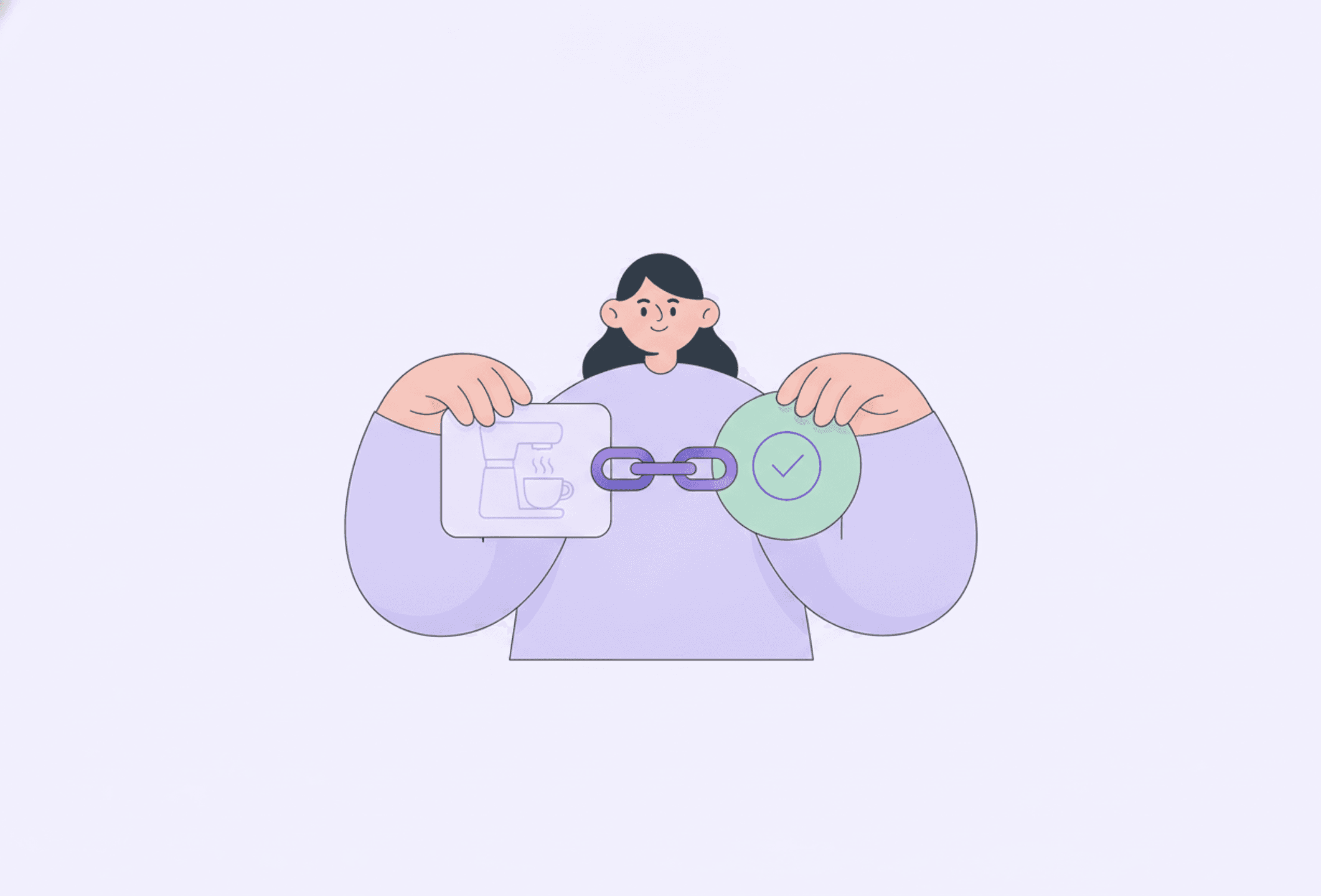
You already have dozens of rock-solid routines: you brush your teeth, you make coffee, you sit down on the sofa. Habit stacking means attaching the new habit right after an existing one:
After I [start the coffee maker], I will [write down three things I want to do today].
The old routine becomes the reminder. You don't have to remember the new habit — the existing one does the work for you. Pick an anchor that happens about as often as you want the new habit to, and that naturally leads into it. Adding "three deep breaths" after you sit down in the car is a good anchor; adding it "sometime in the afternoon" is no anchor at all, because there's no trigger.
In Stedo you build your own reusable routine groups with your own names, so the new habit always shows up in the right context — you're not locked into fixed slots. You can schedule a group on certain weekdays, on an interval, or on set dates, and if you like you can place it in an optional time window such as Morning, Day, Evening or Anytime. The same group is reused every time, so you never have to rebuild it.
3. Make it obvious and easy
Your environment decides more than your willpower does. We mostly do whatever is easiest, not whatever is "right". So make the right behaviour the easiest thing in the room:
- Lay out what you need the night before — books, shoes, water bottle.
- Remove friction: one fewer step between you and the habit.
- Add friction to what you want to do less of: charge your phone in another room.
- Make the next step visible: leave the gym bag where you'll trip over it.
A gentle reminder at the right moment works like a nudge without a lecture. The goal isn't to force discipline — it's to make the obvious choice visible before you've had time to think. The fewer decisions a habit needs in the moment, the more likely it is to happen.
4. Track it where you can see it
What you can see, you can keep going. Visible tracking does two things: it gives a small reward every time you check off, and it reveals patterns you'd otherwise miss.
- Streaks create an unbroken chain you don't want to break — 3, 7 and 30 days become natural milestones.
- A 12-week activity heatmap shows the whole quarter at a glance, so a single gap looks small in context.
- Visible achievements make progress feel real, not just theoretical.
The chain itself becomes the motivation. When you've got seven green days in a row, you don't want to be the one who breaks them — and that small pull is often exactly enough to carry you through. The heatmap is especially kind on the dull days: in the moment a miss feels like a big failure, but a quarter of mostly-filled squares tells a different, truer story about how often you actually show up.
5. Reward it
The brain repeats what feels good. Build a small reward right after the habit while it's still new and fragile — the shorter the gap between behaviour and reward, the stronger the link.
- Check it off — the act of checking off is a micro-reward in itself.
- Collect points for completed routines and trade them in for your own, self-chosen rewards.
- Quietly tell yourself: "I did that."
Every completed routine earns points up to a daily cap, and late check-offs still count — because a habit done at 10 p.m. is still done. You design what the points can be traded for, so the reward feels meaningful to you specifically: a coffee out, an evening with no guilt, a small thing you usually put off. One tip: make the reward a little smaller than you think it needs to be. It's the consistency, not the size, that teaches your brain the habit pays off.
6. Recover fast after a miss
You will miss a day. Everyone does. The rule that decides everything is simple: never break the chain twice.
One missed day is an accident. Two missed days in a row is the start of a new pattern — now you're learning to skip instead of to do. The goal isn't perfection. It's never letting one skip become two.
- Plan for the miss in advance: "If I slip, I'll do the tiny version tomorrow."
- Don't add shame — shame only stretches the pause out by making it hard to come back. Just return.
- Use skip-exceptions for days you knew would be different. A planned skip doesn't break your streak, so a sick day or a trip won't wipe out months of momentum.
That's the difference between a habit that survives real life and one that collapses at the first bump. A streak is valuable precisely because it feels a shame to break — but it should serve you, not become one more thing to feel bad about. Skip-exceptions exist to separate "I chose to skip this" from "I failed".
How long should you keep going?
With the Lally range in mind: plan for two to three months before a habit feels automatic, and don't be surprised if a harder habit takes longer still. The sign you're close isn't a date on the calendar but a feeling — it starts to feel strange not to do the habit. On that day you no longer have to think about it; it just happens, like brushing your teeth.
Through that window, the system does the work motivation can't. The tiny habit needs almost no energy. The anchor remembers for you. Tracking and points keep it rewarding. And skip-exceptions make sure a bad day doesn't erase weeks of effort. Your only job is to show up in the tiny version, over and over, until the repetition does the rest.
Put it all together
Pick one habit — not five. Make it absurdly tiny. Anchor it to something you already do. Lay out what you need, track the chain where you can see it, reward every check-off — and if you miss, do the tiny version tomorrow without the shame. Add a new habit only once the first one feels automatic; one at a time sticks, five at once collapses.
That's the real answer to how to build a habit that lasts. Stedo brings the whole system together — reusable routine groups, streaks, a heatmap, points and gentle reminders — in one calm place, so you can spend your energy on the habit instead of keeping track of it.
Frequently asked questions
How long does it really take to build a habit?
On average about 66 days, according to Lally et al. (2010), with a wide range from roughly 18 to 254 days depending on the person and how hard the habit is. The often-repeated 21-day figure is a myth with no scientific basis.
Will missing one day ruin my habit?
No. Research shows a single missed day doesn't harm long-term habit formation. What breaks a habit is giving up after the miss. The rule is simple: never break the chain twice in a row — do the tiny version the very next day.
Why should I start so small?
Because a tiny habit needs almost no energy or motivation, so it survives even a bad day. A small habit you do every day beats a big habit you do sometimes. Once the tiny version is steady, let it grow on its own.
How does Stedo help me keep a habit going?
Stedo brings the system together in one place: your own reusable routine groups with your own names — you can optionally place them in time windows like Morning, Day, Evening or Anytime — streaks and a 12-week heatmap for visible tracking, points you trade for your own rewards, gentle reminders, and skip-exceptions so a planned day off doesn't break your streak.