How to Focus When You're Tired After a Bad Night
Three hours of sleep. You sat down at nine, and at twenty to twelve you have read the same paragraph four times.
Three hours of sleep. You sat down at nine with a clear idea of what today needed to be.
It is now twenty to twelve. You have opened the document twice, read the same paragraph four times, answered two emails badly and made a coffee you do not remember drinking.
Trying to focus when tired is not a discipline problem. Short sleep takes executive function first - working memory, decision-making, and, most inconveniently, your ability to judge your own state - so the harder you push, the worse your judgment about whether pushing is working. A bad-sleep day is won by changing what you ask of yourself and by moving the failing functions out of your head and onto paper.
What actually goes first
Working memory goes early, which is why the thread disappears halfway through your own sentence and why you re-read the same paragraph without anything sticking.
Decision-making goes next, and it goes quietly. You will still make decisions all day; they will just be worse and faster, and choosing between two options will feel unaccountably heavy.
Self-monitoring goes too, and this is the one that catches people. On short sleep, most of us feel roughly fine after the first hour - the sense of being impaired fades long before the impairment does. Your own report on your state is the least reliable instrument you own today.
And emotional regulation is thinner, so ordinary friction - a curt message, a broken link, a queue - lands harder than it deserves. That is not you being unreasonable. It is the same tank running everything.
Spend ten minutes rewriting the day
This is the highest-value thing you will do today, and it takes about as long as making the coffee.
Pick one thing that actually has to happen and accept that it is the day. Then look for anything that is irreversible, expensive or decision-heavy - the difficult email, the contract, the argument you were going to have, the big choice - and move it. A bad-sleep day is a poor day to decide anything that will still matter in a month.
Rescheduling is not failure here; it is the single most useful skill for these days. And where something genuinely cannot move, do it early, before the afternoon dip makes it worse.
Work from paper, not from memory
On a normal day you can hold a sequence in your head. Today you cannot, so the sequence has to live outside it.
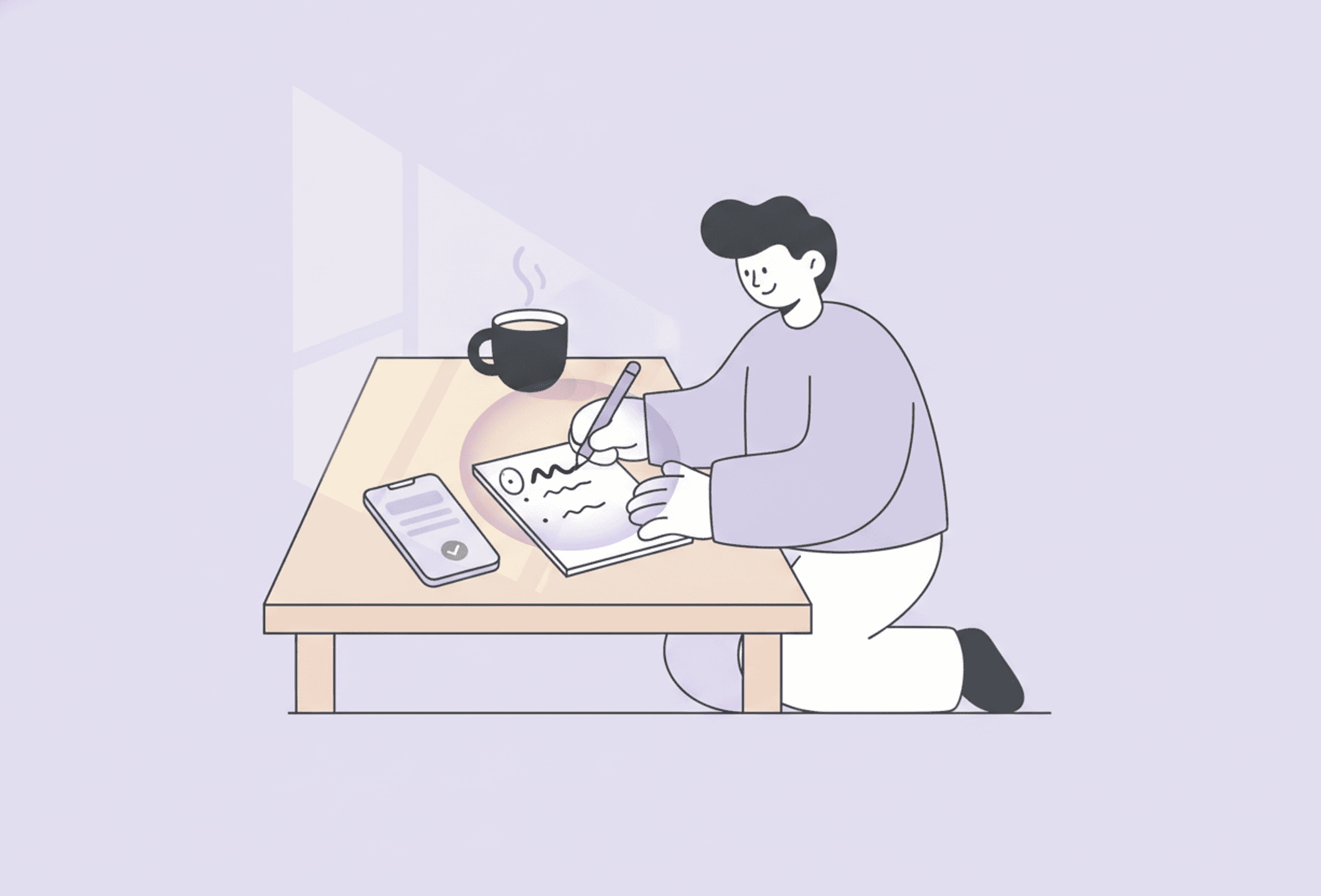
Write the next three steps down at step level - not "finish report" but "open file, paste the three numbers from the email, write the first paragraph" - and cross them off as you go. That is breaking the task down in its most literal form, and on four hours' sleep it is the difference between working and staring.
Leave a note on the desk when you stop for anything, saying exactly where you were. You will need it more than usual.
Shorten the blocks
Whatever your normal working block is, halve it. Twenty minutes on, five or ten off, and expect the fade to arrive earlier - a shorter pomodoro is not defeat, it is matching the plan to the equipment you have today.
A visible timer earns its keep here, because time perception gets noticeably worse when you are short of sleep: forty minutes and ten minutes feel similar, and both feel like nothing was achieved.
Caffeine restores alertness, not judgment
It is worth being clear about what coffee actually buys you. It makes you feel more awake, and it does very little for the decisions - which means its main effect on a bad day is to hide how impaired you are.
Use it, but with two limits: do not treat feeling awake as evidence that your judgment came back, and keep it out of the afternoon, because the fastest way to guarantee a second bad night is to fix the first one with caffeine at four in the afternoon.
Ten minutes of daylight beats a third coffee
Get outside, ideally in the first hour of the day and again after lunch. Light and movement do more for the next hour of alertness than another cup, and morning daylight is one of the few things that helps both today and tonight's sleep.
Walk while you take calls. Stand up between blocks. The tiredness that comes from sitting still and pushing is on top of the tiredness you already have.
Give the day to your hands
Here is the reframe that saves these days: a bad-sleep day is the best day of the month for everything that needs hands rather than judgment.
Laundry, filing, the pile on the chair, the twenty small admin jobs that have been waiting for a slot. They are low on decisions, they are visibly finished when they are done, and they are exactly what you cannot face on a sharp day when your attention would rather be spent on real work. Doing them today converts a written-off day into a genuinely useful one.
If a nap is available, twenty minutes before mid-afternoon is worth more than the hour of half-work it replaces.
Tell people once, and promise nothing
One sentence at the start of the day prevents most of its misunderstandings: "I'm running on about three hours - I'll confirm anything important by email today."
That does two things. It buys you slack, and it gives you a rule that protects you from your own decision-making. Say no to anything new, or at least say "let me check tomorrow", because a tired yes is tomorrow's over-commitment and it always sounds reasonable at the time.
The actual fix happens tonight
The strong pull, having had a useless day, is to work late to make up for it. That is how a bad night becomes a bad week.
Stop at your normal time even if the day was thin, and protect the evening rather than the deficit - most nights lost this way are lost to the hours you reclaim after everyone is asleep, which feel deserved and cost the next day.
And if this is most nights rather than an occasional one, treat it as a health matter rather than a productivity one. Sleep problems are very common alongside ADHD, they are often treatable, and there is no planning trick that fixes chronic sleep loss - that conversation belongs with a doctor.
The short version
Short sleep takes working memory, decision-making and your ability to tell that you are impaired. Spend ten minutes rewriting the day to one real task, move anything irreversible or decision-heavy off it, and work from three written steps rather than memory. Halve your blocks, use a visible timer, get daylight instead of the third coffee, and hand the day to the physical jobs that need hands rather than judgment. Tell one person, promise nothing new, and stop on time - the fix is tonight's sleep, not tonight's overtime.
Keep reading
Frequently asked questions
How can I focus when I am tired?
Change what you ask of yourself rather than pushing harder. Pick one task that genuinely has to happen, move anything irreversible or decision-heavy to another day, and work from three written steps instead of memory, since working memory is the first thing short sleep takes. Halve your usual working blocks, use a visible timer, and get ten minutes of daylight rather than a third coffee.
Why does everything feel so much harder after a bad night?
Because short sleep takes executive function first: working memory goes early, so the thread disappears mid-sentence; decision-making goes next and gets quietly worse; and emotional regulation is thinner, so ordinary friction lands harder than it deserves. The catch is that self-monitoring goes too - most people feel roughly fine after the first hour, so your own sense of how impaired you are is the least reliable instrument you have that day.
Does coffee help when you have not slept?
It restores alertness but does very little for judgment, so its main effect on a bad day is to hide how impaired you are. Use it, but do not treat feeling awake as evidence that your decision-making came back, and keep it out of the afternoon - fixing one bad night with late caffeine is the most reliable way to produce a second one.
What should I actually do with a day after no sleep?
Give it to your hands. Laundry, filing, the pile on the chair, the small admin jobs that never get a slot: they need almost no decisions, they are visibly finished, and they are exactly what you cannot face on a sharp day. Doing them turns a written-off day into a useful one. If a nap is available, twenty minutes before mid-afternoon is worth more than the hour of half-work it replaces.