

The Sunday Reset: A Calm Routine That Saves Your Week
The internet version takes six hours and a matching label maker. The useful version takes ninety minutes with a timer, and it changes how Monday feels.

You have seen the videos. Someone decants their washing powder into a glass jar, meal preps fourteen identical lunches and deep cleans a flat that was already clean, all soundtracked by something ambient. It looks lovely. It also takes six hours, and if that is the bar, you will not do it.
A Sunday reset routine is a short, repeatable session - 60 to 90 minutes - that puts your space, your week and yourself back in a usable state before Monday. Not a deep clean. Not a personality transplant. A reset, in the sense of clearing the decks so next-week-you starts from something workable instead of from wreckage.
The reason it earns its place with an ADHD brain is that it batches all the small maintenance decisions into one predictable slot. Nothing has to be remembered on a Tuesday evening, because Tuesday evening was already handled on Sunday.
Set a timer and work in four blocks
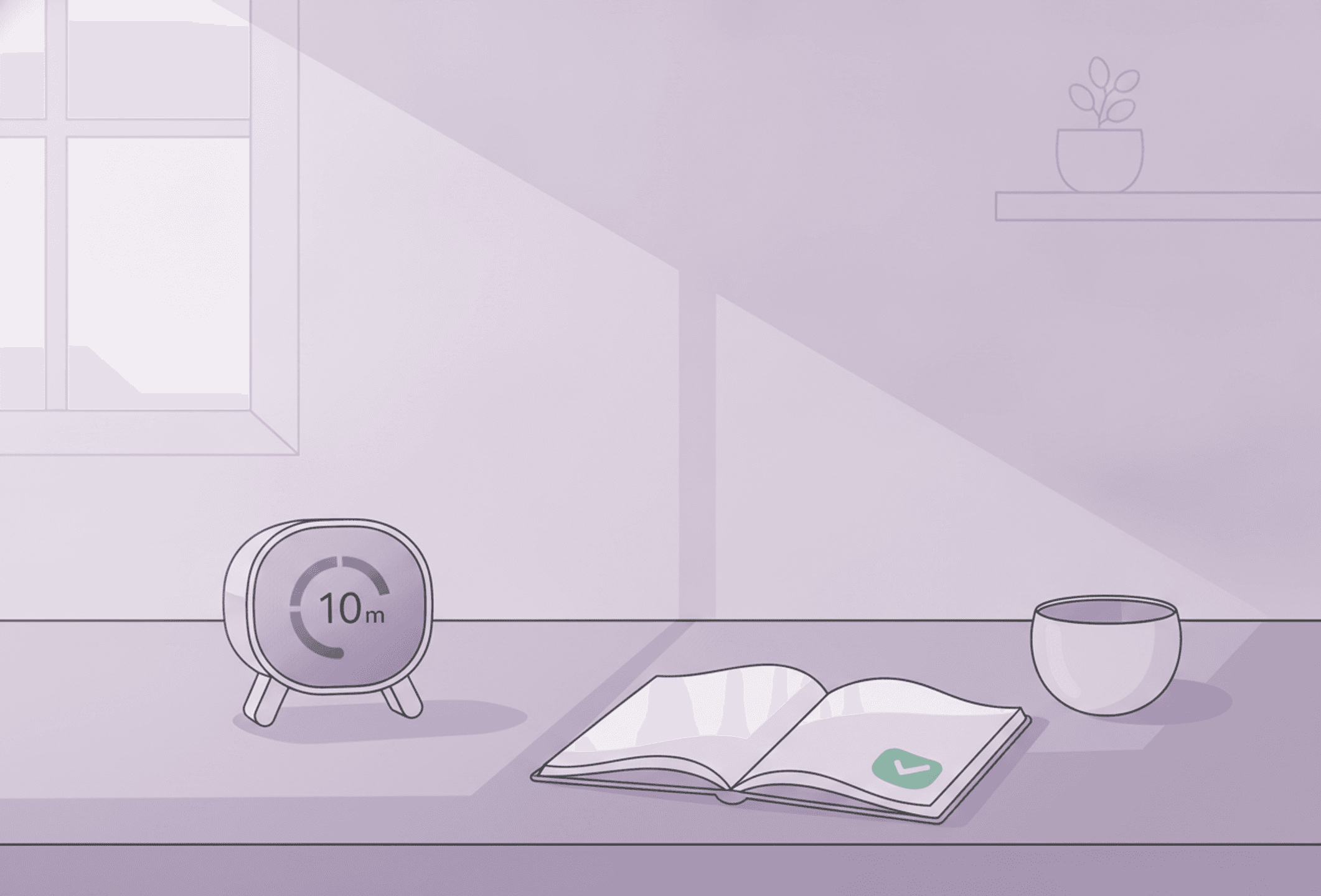
Use a timer, out loud and visible. Without one, the reset either expands to eat the whole day or evaporates after ten minutes. Stedo's focus timer is free and works fine for this, as does a phone timer or a playlist of a known length - when the music stops, the block stops.
1. Space (10-20 minutes)
Surfaces only, and only in the rooms you actually use. Kitchen counter, the table, the floor of the room you spend most time in, one bathroom surface. Not drawers. Not cupboards. Not the mysterious box in the hall.
The goal is not clean, it is clear enough that Monday morning does not begin with an obstacle. If piles are the recurring problem rather than mess in general, they have their own approach in a low-effort cleaning routine.
2. Week (10-15 minutes)
Open the calendar and look at the actual week, not the imagined one.
- What is fixed - appointments, deadlines, things involving other people?
- Where are the crunch points, the days that are already full before they start?
- What are the week's one to three priorities? Not twenty. Three.
- Is anything already impossible, so you can renegotiate it today rather than on the day?
This is deliberately light. If you want the full version - catching loose ends, clearing inboxes, looking backwards as well as forwards - that is the weekly review, and it pairs well with this once the reset itself is a habit.
3. You (15-20 minutes)
The part that gets skipped, and the part that changes how Monday actually feels.
- Shower, wash hair, cut nails - whichever of the basics has drifted.
- Put out Monday's clothes. Decisions made now are decisions your tired morning brain does not have to make.
- Decide roughly what you will eat for two or three days. Rough is fine: "pasta, soup, the leftovers". A vague plan beats standing in the kitchen at seven deciding from nothing.
- Charge things. Put the keys, the card and the bag where they belong.
4. Something kind (10 minutes)
End on a reward, not a chore. Tea and a chapter. A programme. A walk. Anything that marks the reset as finished and pleasant.
This is not a bonus round, it is what makes the routine survive. A ritual that ends in exhaustion gets avoided within three weeks; one that ends in a cup of tea gets repeated.
Make it ADHD-proof
Anchor it to a trigger, not a clock time. "After Sunday lunch" sticks better than "at 14:00", because a specific time is easy to miss by twenty minutes and then abandon entirely.
Use a playlist as the timer. Three albums, four blocks, no clock-watching. Music also supplies the stimulation that makes dull tasks tolerable.
Body double it. Video call a friend who is doing their own reset. Presence is startlingly effective, and nobody has to talk the whole time.
Have a 15-minute version. For bad weeks, the minimum is: clear the kitchen counter, glance at the calendar, put out clothes. That is the whole thing. A reset you actually do at 15 minutes beats a perfect one you skip - and the minimum version is what keeps the habit alive through the weeks when you have nothing to give.
Do not add. Every Sunday you will be tempted to bolt on one more task. Resist it. The routine works because it is short enough to start.
If Sunday evening feels heavy
There is a version of this where the reset is not the problem - the dread is. If Sunday afternoons come with a tightening chest and a sense of the week closing in, that is the Sunday scaries, and it needs a different kind of attention. A reset often helps, because vague dread shrinks when the week becomes specific and visible. But if the feeling arrives regardless of how tidy the flat is, the routine is not what needs fixing.
The point is the starting line
A Sunday reset does not make you a different person. It makes Monday start from a cleared surface, a known plan and clean clothes, instead of from a mess you have to fight before the day even begins. Ninety minutes, four blocks, ending with something kind.
Read more
Frequently asked questions
How long should a Sunday reset take?
Sixty to ninety minutes is enough for most people, split into four blocks: space, week, you, and something kind at the end. Anything longer tends to become a deep clean, which is a different job and much easier to avoid. Keep a 15-minute minimum version for bad weeks - clear one surface, look at the calendar, put out clothes - because a short reset you actually do beats a thorough one you skip.
What should be in a Sunday reset?
Four things. Space: clear surfaces in the rooms you use, not drawers or cupboards. Week: look at the real calendar, name one to three priorities, spot the crunch points. You: the basics that make Monday lighter - shower, clothes out, a rough food plan, keys and bag where they belong. And something kind to end on, so the routine has a reward attached rather than just effort.
How is this different from a weekly review?
A Sunday reset is practical and physical - space, admin, self-care - and takes about an hour. A weekly review is a planning session: catching loose ends, clearing inboxes, looking back at the week that was as well as forward. They complement each other, and the reset is the easier one to start with. Once resetting is automatic, adding a proper review on top is much less daunting.
What if I miss a Sunday?
Do it Monday evening, or do the 15-minute version whenever you next notice. The routine is a rhythm, not a streak, and one skipped week means nothing. The thing to avoid is deciding that because you missed it you should do a huge catch-up version next time - that makes the next Sunday harder to start, which is how routines quietly die.