

Daily Structure Strategies for Adults with ADHD
ADHD daily structure isn't about a rigid schedule. It's about getting things out of your head, anchoring the day with a few light routines, and making each step small enough that it actually happens — even on a low-energy day.
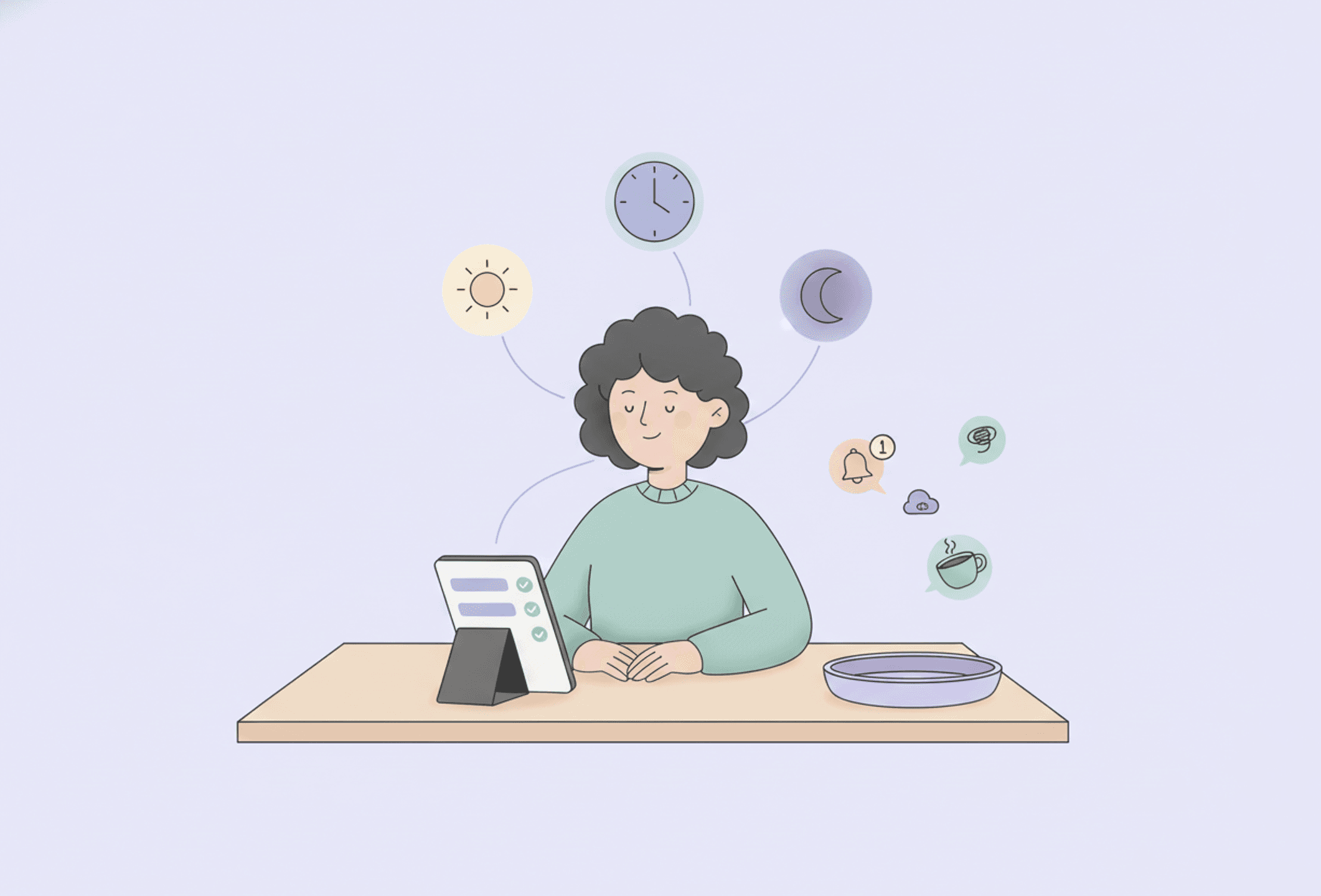
Building ADHD daily structure isn't about forcing yourself into a rigid schedule. It's about setting up a few light anchor points that fit the way your brain actually works — so you can stop holding everything in your head and spend your energy on what matters. This guide gives you concrete, kind strategies you can start using today, without the pressure to get it perfect.
A quick note first: these are practical everyday strategies, not medical advice. If you want support around ADHD in general, a healthcare professional is the right place for that. This is about the structure of your day — and that's something you can start shaping yourself, at your own pace.
Why structure helps
For a brain that easily gets overwhelmed, loses the thread, or struggles to get started, an outside structure does something important: it takes over the work that would otherwise keep spinning inside your head. When the day has a few fixed anchor points, you don't have to constantly decide what comes next. The decisions are already made. That frees up mental bandwidth — and lowers the background stress of trying to remember everything at once.
So structure isn't a way to become "more disciplined". It's a way to put less pressure on memory and willpower, and more on a system that carries you even on the days your energy runs low. Good ADHD daily structure doesn't feel like a straitjacket. It feels like a railing to lean on.
Start where you are
You don't need to overhaul your whole life. Pick one or two of the strategies below, try them for a week, and let the rest wait. A small change that holds beats a big one that collapses after three days.
Get everything out of your head
The first step toward structure is to stop using your head as a notepad. Holding ideas, tasks and reminders in memory is both exhausting and unreliable — and every thing you try to remember takes up space that could have gone to actually doing something.
The fix is to externalise: get it all out of your head and into one place you trust.
- When a thought pops up — "I need to call the dentist" — capture it right away, before it disappears.
- Collect everything in one place instead of scattered notes, apps and screenshots.
- Separate capturing from doing. Writing something down doesn't mean you have to deal with it now.
This is one of the most relieving habits there is. When your brain knows nothing will be forgotten, it can relax. Stedo has a brain-dump inbox where you quickly capture whatever shows up — you can type it or speak it — and sort it later. The thought is out of your head in seconds, and you can get back to what you were doing without losing your place.
Anchor the day with a few light routines
It's tempting to think the answer is a minute-by-minute schedule for the whole day. For most ADHD brains, the opposite works better: a few anchor routines instead of a rigid timetable that collapses the moment something unexpected happens.
Think of the day in three or four blocks rather than one long list:
- A morning routine that gets you going — three or four small steps, not ten.
- A day routine that keeps you on track through the middle of the day.
- An evening routine that helps you land and set up tomorrow.
- An "anytime" routine for things that don't belong to a particular time.
These routines are anchors, not a rulebook. Between them, the day can be as flexible as it needs to be. The point isn't to control every minute — it's to know that certain things come back in roughly the same shape each day, so you don't have to invent the day from scratch every morning.
Make the routines reusable
The best thing about a routine is that you build it once and then stop having to think about it. In Stedo you create your own reusable routine groups — with your own names and optional start times — so you're not locked into fixed slots. If you like, you can sort them into broad time windows like morning, day, evening and anytime, but that's optional. The same group shows up every time it should, and you can schedule it on certain weekdays or on an interval, so the right steps are always there in the right context — without you rebuilding anything.
Make tasks tiny and concrete
A big, vague task is almost impossible to start. "Sort out my finances" or "clean the garage" says nothing about what you actually do first, and the brain responds by putting it off. That isn't laziness — it's a task with no way in.
The trick is to shrink the task until the first step is absurdly small and completely concrete:
- "Clean the garage" becomes "set out three boxes".
- "Sort out my finances" becomes "open one envelope".
- "Start exercising" becomes "put on my shoes".
- "Reply to the email" becomes "write one sentence".
The first step should be so small it feels almost silly not to do it. Once you're moving, it's usually easier to keep going — the threshold was always the start, not the work itself.
In Stedo you can break a task into sub-steps, and if you're stuck, the app's AI can suggest what those steps might be. That removes the hardest part: working out where to even begin. A long, intimidating task turns into a row of small, checkable steps — and each check-off gives a little push forward.
Support your sense of time
Many people with ADHD find that time behaves strangely — ten minutes and two hours can feel the same, and "I'll do it soon" easily turns into the whole afternoon. That's not a character flaw. It just means it helps to make time visible and concrete rather than trying to feel it.
A few practical ways:
- Use a timer to give time a shape. Watching it tick turns abstract time into something concrete.
- Work in short, defined sessions with built-in breaks instead of aiming to go "until it's done".
- Set gentle reminders at transitions — the start of a routine, morning and evening — so you don't have to keep the clock in your head.
Stedo's focus timer is made for exactly this. You pick a session — 25/5, 50/10 or short 15/3 — and let the timer carry your sense of time for you. You don't have to guess how long you've been at it; the session starts and ends on its own, with a break built in. And the gentle reminders nudge you at transitions without lecturing, so a task doesn't quietly swallow the whole morning.
Build in reward and dopamine
An ADHD brain is strongly drawn to what feels rewarding now, and easily loses interest in things whose payoff is far away. You can use that instead of fighting it: build small, fast rewards into the structure so it becomes something the brain actually wants to come back to.
- Make the check-off visible — the tick itself is a micro-reward.
- Tie a small, immediate reward to the thing you usually put off.
- Celebrate progress you'd otherwise take for granted.
In Stedo you collect points for completed routines — ten per routine, up to a daily cap — and late check-offs count too, because a routine done at ten at night is still done. You decide what the points can be traded for, so the reward feels meaningful to you specifically. On top of that, achievements and streaks make progress visible and a little addictive — in the good way.
Reduce friction in your environment
You mostly do whatever is easiest, not whatever is "right". So instead of relying on willpower, change your surroundings so the right choice becomes the easiest thing in the room.
- Lay out what you need the night before, so the morning has fewer decisions.
- Remove a step between you and what you want to do — the fewer obstacles, the more likely it happens.
- Add friction to what you want to do less of: charge your phone in another room.
- Make the next step visible, so you trip over it instead of having to remember it.
Every decision you remove is energy saved for things that actually need it. Structure doesn't only live in an app — it also lives in how your kitchen, your desk and your hallway are set up.
Recover without shame after an off day
There will be days when nothing goes to plan. That isn't a sign the system doesn't work — it's a completely normal part of being human, and especially of having a brain prone to ups and downs. What matters isn't that you miss, but what you do afterward.
The most important rule is simple: an off day is an event, not a verdict. Shame only makes the pause longer, because it makes coming back feel hard. Just return — in the tiny version if you need to.
- Plan for the off days in advance: "If it all falls apart, I'll just do the first step of my morning routine."
- Measure success over weeks and months, not single days.
- Use skip-exceptions for days you knew would be different. A planned skip doesn't break your streak, so a sick day or a chaos day won't wipe out weeks of momentum.
Stedo is built to be kind here. Skip-exceptions exist precisely to separate "I chose to skip this" from "I failed", and a 12-week heatmap shows the whole quarter at a glance — so a single gap looks small in its proper context. A 9-point mood check-in also lets you notice how the days feel over time, so patterns become visible without you having to hold them in your head.
Keep it flexible
An honest closing thought: the best structure is the one you actually use, not the one that looks most impressive. If a routine feels like a straitjacket — make it smaller. If a block never happens — move it or drop it. The structure should serve you, not the other way around. It's allowed to change as your life changes.
Want to understand the why? Read our deeper guides on object permanence, hyperfocus and time blindness in ADHD.
Start with one thing. Put what's spinning in your head into an inbox you trust. Anchor the day with a single light routine. Make the next step absurdly small. And when a day goes sideways, start again tomorrow without the shame. That's how ADHD daily structure actually gets built — small, kind and sustainable. Stedo brings all of this together in one calm place, so you can spend your energy on living the day instead of keeping track of it.
Frequently asked questions
Do I need a detailed schedule to build ADHD daily structure?
No. For most people, a few light anchor routines — morning, day, evening — work better than a minute-by-minute schedule that collapses at the first unexpected event. The idea is to have a couple of fixed anchor points to lean on, and let the day stay flexible between them.
How do I get started on a task that feels impossible to begin?
Shrink it until the first step is absurdly small and completely concrete. "Clean the garage" becomes "set out three boxes". Once you're moving, it's usually easier to keep going. In Stedo you can break a task into sub-steps, and the AI can suggest what those steps might be.
What do I do when I miss a whole day?
Treat it as an event, not a failure. Shame only makes the pause longer. Return the next day, ideally in a tiny version. Use skip-exceptions for days you knew would be different, so a planned skip doesn't break your streak or erase weeks of progress.
How does Stedo help me build daily structure?
Stedo brings it together in one place: a brain-dump inbox, your own reusable routine groups that you can optionally sort into time windows like morning, day, evening and anytime, sub-steps with AI suggestions, a focus timer and gentle reminders for time awareness, points and your own rewards, plus skip-exceptions and a 12-week heatmap so an off day doesn't undo your progress.