


Mood check and insights
Check in with how you feel in a few seconds and spot patterns over time. Weekly reflection and deeper insights are included in Stedo Plus.
What you can do
A calm check-in with how you feel.
Quick mood check
Log how you feel in a few seconds.
Mood over time
Watch your mood unfold and spot patterns.
Insights
Weekly reflection and deeper insights are included in Stedo Plus.
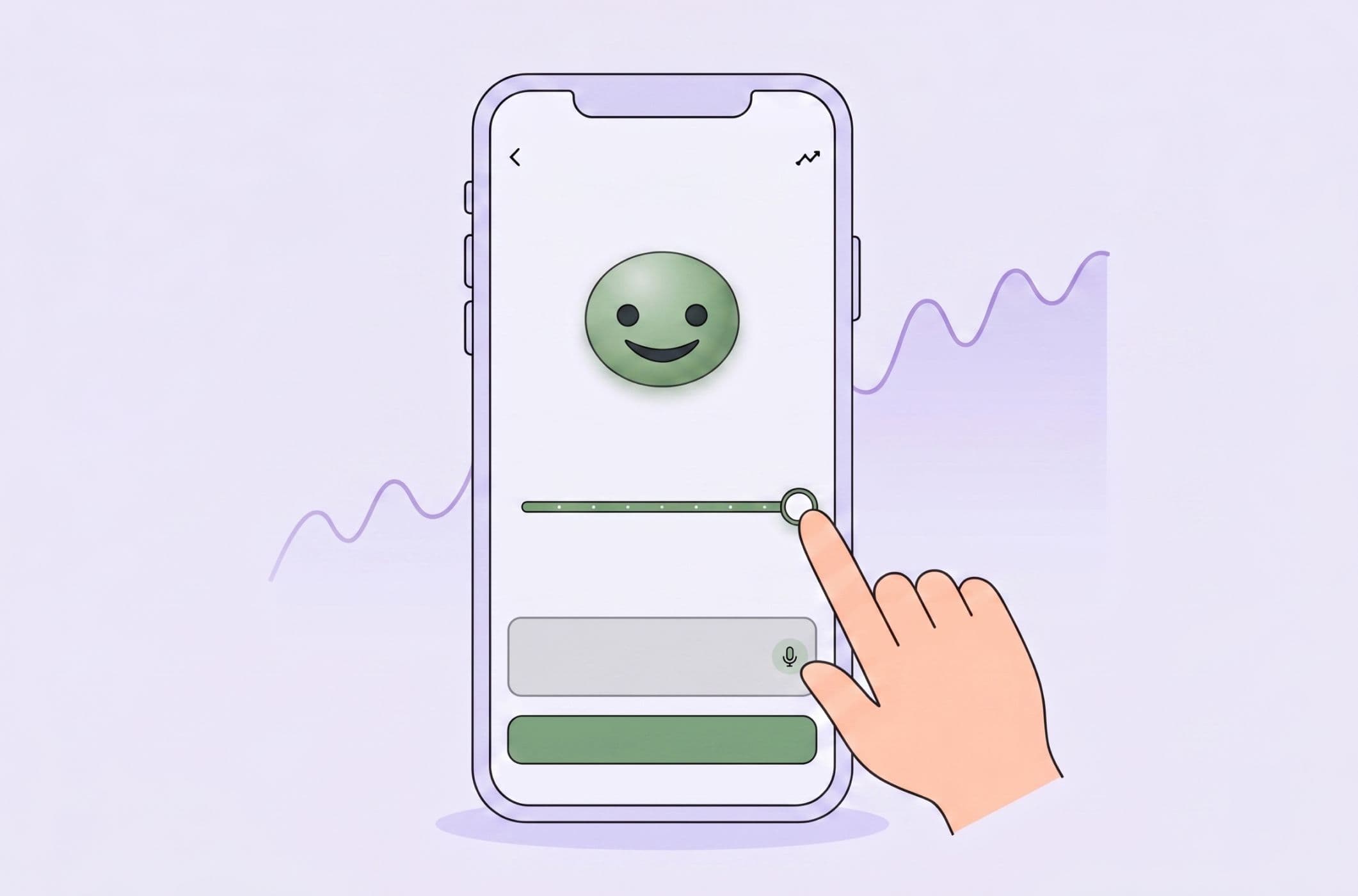
A calm mood check, whenever it suits you
Sometimes there's no time to stop and feel out how the day actually feels. Stedo's mood check is made for exactly that everyday life: you log how you feel in a few seconds, whenever it suits you. No form to fill in, no long questions to answer. Just a small moment of reflection that fits in the middle of everything else.
The idea is simple. The easier it is to check in with yourself, the easier it becomes to do it a little more often. Stedo is a calm everyday app for planning and routines on iPhone and Android, and the mood check is a natural part of that whole. You can explore all the features if you want to see how they fit together, or start with one single thing: noting how you feel right now.
How a quick mood check works
A mood check in Stedo takes only a couple of seconds. You open the app, mark how you feel and you're done. That's the whole point — that it should be quick enough to fit into a short break, between two tasks or just before you put your phone down for the evening.
You decide when and how often. There's no right or wrong number of check-ins. For some, checking in in the morning and the evening works well; for others it's only now and then. Both ways work, because the tool adapts to you and not the other way around.
- Quick: log your mood in a few seconds.
- Flexible: do it when it suits you, not according to a schedule you have to keep.
- Simple: no long form, just a quick mark.
This lightness is deliberate. A mood journal that feels demanding easily becomes one more thing on the to-do list. Stedo's mood check should feel like the opposite — something small and friendly you do for your own sake.
Your mood over time
Once you've checked in a few times, something nice starts to happen: you get a picture of your mood over time. Instead of single moments, you see a history you can look back on. How has the past week felt? What does the past month look like, from a little distance?
Seeing your mood gathered in one place is a simple way to strengthen your self-awareness. You don't have to remember exactly how each day was — the check-ins are already there, calmly saved, ready to look back on whenever you like.
The history is there for you to look at at your own pace. Some open it often, others rarely. What matters is that it's there, a quiet log of how time has felt.
Noticing patterns
When you look at your mood over time, you can notice patterns. Maybe certain days of the week feel different from others. Maybe you notice your mood tends to swing at certain points. Stedo draws no conclusions for you — you're the one who sees, you interpret, and you decide what a pattern means for you.
This is the whole idea of a simple mood journal: not to get an answer key, but to get something to look at. Sometimes it's enough to see your own history to understand yourself a little better. And sometimes you see nothing in particular at all — that's perfectly fine too.
If you'd like to read more about how small, recurring actions can become part of everyday life, there's the blog on habits, where we write calmly and concretely about exactly that.
Weekly reflection and deeper insights (Stedo Plus)
For those who want to go a step further, weekly reflection and deeper insights are available as part of Stedo Plus. It's a calm way to sum up the week that's been and see your mood in a slightly bigger context.
The weekly reflection is part of Plus. The quick mood check and seeing your mood over time, however, are completely free — they belong to the foundation of Stedo and cost nothing. So you can start logging and see your history right away, without paying for anything, and later explore Plus if and when you want that extra reflection.
- Free: quick mood check and mood over time.
- Stedo Plus: weekly reflection and deeper insights.
This is not a medical tool
It's important to be clear: Stedo is not a medical device, not a treatment, not a diagnosis and not a healthcare service. The mood check is a simple tool for everyday self-awareness — a way to note how you feel and look back on it. Nothing more, and nothing it claims to be.
Stedo makes no diagnoses, gives no health advice and cannot replace contact with healthcare or other professional support. If you're feeling unwell or have concerns about your health, turn to healthcare services or other qualified help. The mood check can sit alongside such support as a small everyday habit, but it's never something to rely on instead of it.
We say this plainly and honestly, because this is an area where clarity means everything. Stedo wants to be a calm companion in everyday life — no more than that, and we promise no more than that.
When a mood check can be nice in everyday life
A mood check doesn't have to serve some grand purpose to be worth doing. Often it's the small moments that make a difference to how the day feels:
- A short breath in the morning before the day gets going.
- A pause in the middle of a chaotic afternoon, just to check in with yourself.
- A calm mark in the evening, like a little line under the day.
- A way to regularly see your mood over time and recognise your own rhythms.
For many, it's easiest when the check-in gets to be small and undemanding. That's why Stedo keeps it so simple. If you want to see how the mood check fits into a calmer everyday life as a whole, you can start with Stedo, and if you'd like to know how the app thinks about different ways of functioning, there's Stedo for ADHD and Stedo for autism.
Start where it feels easy. Log how you feel once, see how it feels, and let the rest grow at your own pace.
Frequently asked questions
Check in with yourself
Download Stedo and do your first mood check.


Available for iPhone and Android. Not a medical device.